
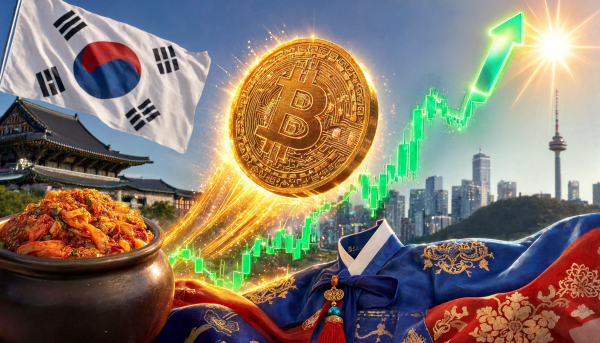
[Digital Today reporter Yoonseo Lee (이윤서)] A “kimchi premium,” where bitcoin trades at a higher price on South Korean exchanges than overseas, has reappeared.
On Sept. 1, foreign media including Bitcoin Magazine and Bloomberg reported that bitcoin on Upbit, South Korea’s largest exchange, was priced about 1 percent higher than on Binance.
This phenomenon repeats in the domestic market because of market structure. South Korea has relatively strict controls on capital movement and tight trading regulations, making it difficult for price gaps with overseas markets to narrow quickly. If retail demand strengthens, prices rise further. Unlike global markets, where bitcoin is commonly traded against the dollar, bitcoin-to-won trading accounts for a larger share in South Korea.
Bitcoin’s own trend was also cited as a factor widening the domestic price gap. Bitcoin showed no major change over the past 24 hours and seven days and is currently holding above the $77,000 level. Over the past month, it has risen 24 percent.
Bitcoin’s upswing gained momentum after the U.S. Treasury said it would at least double the size of its August buyback operations for liquidity support. The announcement weighed on the dollar but was favorable for non-interest-bearing assets such as bitcoin and gold.
Policy expectations also affected market sentiment. U.S. President Donald Trump called the long-discussed crypto clarity bill “important legislation” that week and urged Congress to pass it. The industry has called for clear rules to distinguish whether digital assets are securities, commodities or payment stablecoins. Expectations that a regulatory framework could soon be put in place were reflected as positive news across the crypto market.
Short-term expectations among domestic investors also remain alive. On prediction market Polymarket, the probability that bitcoin will exceed $82,500 this month is priced at 59 percent. Some speculative players cite this to suggest the possibility that a bear market has ended.
Still, the current kimchi premium of about 1 percent remains limited compared with the 21.5 percent recorded in 2022. Rather than a sign of overheating in the domestic market, it is seen as a short-term supply-demand imbalance as retail investor interest in bitcoin’s rise returns.
Whether the kimchi premium expands will also be a key indicator of domestic investor sentiment. If the premium rises along with bitcoin prices, it could be interpreted as a sign that retail investors have begun chasing the rally in earnest. If the premium shrinks quickly, it could mean domestic demand only flowed in temporarily.
In the domestic market, the extra price paid versus overseas markets appears to have returned as retail demand overlaps with global drivers of the rise. Whether bitcoin’s uptrend continues, and whether the price gap on domestic exchanges proves temporary, are expected to be key points to watch.
 Yoonseo Lee
yslee@d-today.co.kr
Yoonseo Lee
yslee@d-today.co.kr