
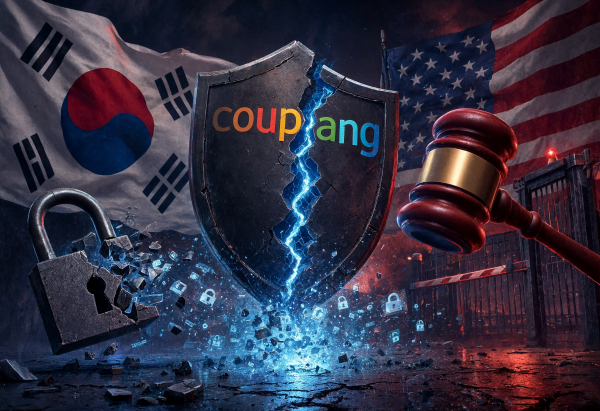
A Korea-U.S. dispute involving Coupang has raised the possibility of spreading into U.S. pressure on South Korea for additional tariffs.
On Aug. 31, U.S. congressional officials and people around Coupang believe Congress or the White House could move to respond, including with additional tariffs, if the dispute drags on, CNBC reported.
At issue is the South Korean government’s response after a Coupang personal data leak case disclosed last November. A report written by Republican members of the U.S. House Judiciary Committee claimed the South Korean government launched an unprecedented offensive against Coupang, which is headquartered in Seattle. Coupang says the scale of the leak was limited, but the South Korean government judged the risk of consumer harm from leaked personal information to be greater. It then held a hearing, raised the possibility of criminal punishment for Coupang’s interim chief executive, and in June imposed 625 billion won in penalties for alleged data leaks and illegal collection of personal information.
U.S. political circles call it an "allies" issue, with some seeking tariff pressure.
In U.S. political circles, some say the matter should not be seen as a simple corporate dispute. Chris Stewart (크리스 스튜어트), head of the lobbying firm Skyline Capitol, who has an advisory relationship with Coupang, said the matter concerns relations between the United States and South Korea, two key allies. He said he does not want the two countries to take retaliatory steps, but added that if the South Korean government does not back down, the U.S. president’s tariff authority could have a strong effect.
Calls for trade pressure have also continued. Bernie Moreno (버니 모레노), a Republican U.S. senator, urged U.S. Trade Representative Jamieson Greer (제이미슨 그리어) last week to push for a formal investigation into South Korea and to review additional tariffs. In January, Coupang investors Greenoaks Capital Partners and Altimeter Capital also petitioned for a Section 301 investigation, asking for a probe into whether the South Korean government discriminated against Coupang and for a review of additional tariffs. There has been no announcement yet that a formal investigation directly targeting the Coupang matter has begun. In USTR materials, the case is classified as a "petition".
Tensions in Korea-U.S. trade relations are also intertwined with the matter. U.S. President Donald Trump said on Aug. 16 he would scale back annual joint military drills with South Korea, but a White House official said there was no direct link to the Coupang matter. The official pointed to a 2025 executive order targeting foreign governments that excessively regulate U.S. technology companies, and said the South Korean government’s position has differed from that of the United States on several bilateral issues.
As the two countries readjusted a 2025 trade deal, South Korea agreed to invest $350 billion in U.S. shipbuilding and national security and to reduce regulations on U.S. companies, in return for lower tariff rates. But friction continued as related projects were delayed in being finalized, and the Trump administration imposed new import tariffs in July on several countries including South Korea. The U.S. Trade Representative’s office announced measures in July applying a net tariff rate of 10 percent or 12.5 percent to some South Korean products.
The two sides also differ sharply over the leak scale and laptop recovery.
The two sides’ claims differ widely over the scale of the leak. The South Korean government said 37.55 million people were affected by the personal data leak, but the U.S. congressional report claimed information actually stored and kept by a former employee was related to about 3,000 accounts. The difference stems from how to distinguish the scope of leaked information from the scale of information actually stored.
The U.S. congressional report also included a claim that South Korea’s National Intelligence Service was involved in recovering a laptop thrown into a river in Shanghai. The report said the South Korean government had Coupang hire divers to retrieve the laptop. The South Korean government denied it in full. South Korea’s embassy in Washington said the National Intelligence Service only held working-level consultations to share information and prevent further damage related to a large-scale personal data leak, and never coerced or instructed Coupang to take specific measures.
Washington’s reaction has not been one-sided. Some Democrats have pointed to what they call an excessive Republican focus on Coupang, whose U.S. business base is limited. By contrast, Democratic lawmakers from Washington state, where Coupang is headquartered, also expressed concern over the South Korean government’s response.
The Republican report by the U.S. House Judiciary Committee defined South Korea’s response to Coupang as discriminatory action against a U.S. company, but the South Korean government is pushing back, saying the report largely reflected Coupang’s claims. With the two sides at odds, the Coupang dispute is expanding beyond corporate regulation into additional tariffs and trade issues, and even into a factor that could affect the Korea-U.S. alliance relationship. Republicans on the U.S. House Judiciary Committee in July disclosed a report claiming the South Korean government treated U.S. companies in a discriminatory way.
 Seung-ah Yoo
ysah@d-today.co.kr
Seung-ah Yoo
ysah@d-today.co.kr