
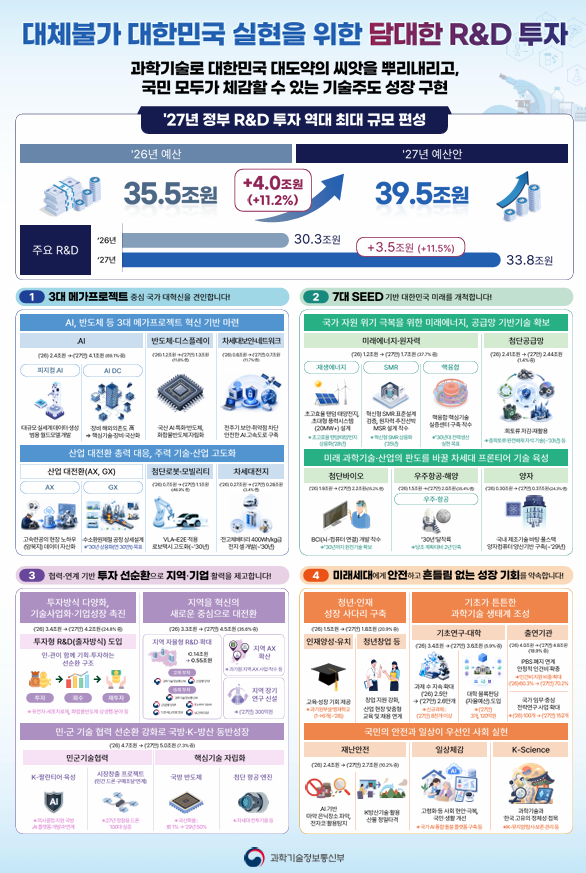
The government's draft research and development (R&D) budget for next year was set at 39.5 trillion won, up 11.2 percent from this year. It will increase investment in strategic technologies such as artificial intelligence (AI), semiconductors, quantum and space aviation, and will put a record 3.3 trillion won into new projects.
The government on Monday approved a draft 2027 budget plan at a Cabinet meeting that includes the measures. Key R&D spending allocated and coordinated by the Ministry of Science and ICT's Office of Science and Technology Innovation totals 33.8 trillion won, up 11.5 percent, or 3.5 trillion won, from this year. The overall increase in the government's R&D budget is 4 trillion won.
According to the ministry, the government's R&D budget growth rate remained in double digits next year following 19.9 percent this year. It also far exceeds the 7.2 percent average annual growth rate of the government's R&D budget over the past 20 years. Park In-kyu (박인규), head of the Office of Science and Technology Innovation, stressed that the result reflects the people's sovereignty government's firm commitment to expanding R&D investment.
The government will first invest a record 3.3 trillion won in new R&D projects that will serve as the foundation for growth and a leap forward. For large R&D projects with total project costs of 100 billion won or more, it plans to shorten the review period from about 2 years under the existing preliminary feasibility study to 3 months, in order to invest quickly in needed technologies. The ministry previously reviewed 38 large projects and reflected 23 of them in next year's budget.
Lee Jae-heun (이재흔), director-general of the ministry's R&D Investment Review Bureau, said on the shorter review period for large R&D projects: "Over 3 months, advisory committee members and private-sector experts examined the completeness of the planning for 38 projects and investment efficiency." He explained: "After a multi-layered review, we decided to newly reflect 23 projects."
It also pushed spending-structure adjustments that reflect project evaluation results in the budget and restructure existing projects. It focused on improving investment effectiveness by revising project structures rather than simply cutting budgets. It reinvested all secured funds back into the R&D field.
It will also expand investment in the "10 NEXT strategic technologies," including AI and semiconductors, to 13.8 trillion won next year from 11 trillion won this year. The 10 strategic technologies include AI, next-generation security and networks, semiconductors and displays, advanced robots and mobility, next-generation batteries, future energy and nuclear power, innovative and future materials, advanced bio, space aviation and oceans, and quantum.
Among them, it will inject 5.8 trillion won into three mega projects for a national leap forward, including semiconductors, physical AI and AI data centers (AIDC). It will focus 3.7 trillion won in investment on seven SEED areas to foster future new industries, including small modular reactors (SMR), renewable energy, nuclear fusion, quantum, space aviation, advanced bio and advanced supply chains.
It will also strengthen R&D support for the private sector and regions. The government will introduce "investment-type R&D," which recovers outcomes after investment and reinvests them, and will expand autonomous R&D in which regions design projects independently, as well as defense and K-defense industry R&D investment. It aims to raise private-sector and regional innovation capabilities and link them to economic vitality.
It will also increase support for researchers and future talent. It will expand training for young and science and technology talent and increase the number of basic research projects, while supporting stable labor costs at government-funded research institutes to create an environment in which researchers can focus on research. It will also expand investment in R&D directly linked to people's quality of life, such as disaster and safety. The ministry said improvements in researchers' treatment would be discussed with fiscal authorities and would continue to be improved gradually.
The government also strengthened a "one-team" system in which relevant ministries and private experts participate together in the R&D budget allocation process. Centering on private experts, it reviewed large R&D project plans and carried out new project consulting and briefing sessions for expert committee members, supplementing plans from the project planning stage. It also expanded inter-ministerial cooperation from major R&D budget allocation and coordination through drafting the government's budget plan.
Park said, "2027 is a golden time to create results within the next 4 years," adding, "Until the government budget plan is finalised, we will fully support detailed planning and supplementation for next year's R&D, and we will also carefully manage execution and oversight."
 Jin-ho Lee
jhlee26@d-today.co.kr
Jin-ho Lee
jhlee26@d-today.co.kr