
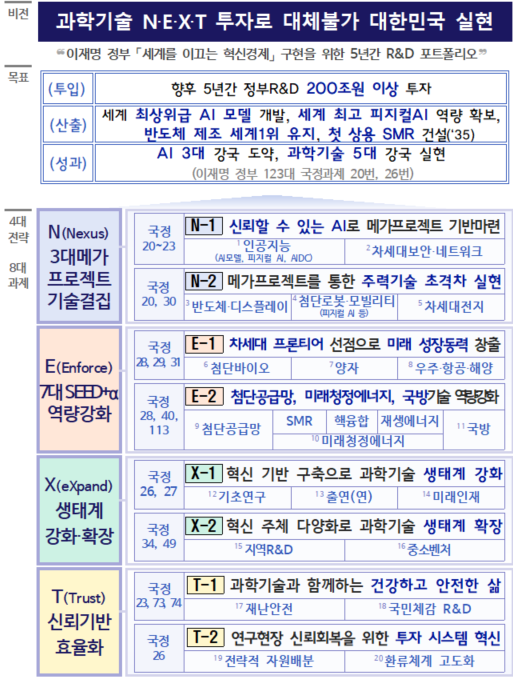
The government will invest more than 200 trillion won in research and development over five years through 2030. It will focus technological capabilities on three mega projects including AI, semiconductors and physical AI, and will also prioritise support for seven future growth engines such as advanced bio, quantum and aerospace.
The Ministry of Science and ICT said on Sept. 1 it had finalised the second national mid- to long-term R&D investment strategy for 2026 to 2030 after the ninth deliberation meeting of the National Science and Technology Advisory Council approved it on Aug. 31. This is the first time the government will invest more than 200 trillion won in R&D over five years.
The strategy is the top-level plan that sets the direction of national R&D investment over the next five years. It presents national missions and performance targets, annual milestones and an investment portfolio, and will be reflected each year in national R&D investment directions and in budget allocation and adjustments.
The government structured the strategy into four pillars and eight tasks: N (Nexus) to concentrate technology in three mega projects; E (Enforce) to strengthen capabilities in seven SEED+alpha areas; X (eXpand) to strengthen and expand the ecosystem; and T (Trust) to improve efficiency based on trust.
AI, semiconductors and physical AI to get focused support to strengthen global competitiveness
It will raise global AI competitiveness centred on AI models, physical AI and AI data centres, or AIDCs. It will support development of key technologies in general-purpose artificial intelligence, ultra-high-efficiency technologies, world models based on physical laws, full-stack physical AI and core technologies across AIDC upstream and downstream industries.
The government aims to lift global AI competitiveness to third place from fifth, and targets becoming the global No. 1 power in physical AI and commercialising AIDC exports. It will also foster next-generation security and network technologies including the world’s first commercialisation of 6G and Korean-style quantum-resistant cryptography.
The government will also seek to secure a wider lead in key industries such as semiconductors and displays, advanced robots and mobility, and next-generation batteries. It will develop next-generation HBM and PIM, as well as neuromorphic and compound semiconductors, and will build a 'K-AI semiconductor full package' ecosystem made up of homegrown technologies from AI chips to software and services.
It aims to raise self-reliance in semiconductor materials, components and equipment to 50 percent from 30 percent, and increase the localisation rate for key robot components to 80 percent from 41 percent. For next-generation batteries, it seeks a 25 percent global market share and to regain the world’s top technology level.
Advanced bio, quantum and space among seven SEED areas to be fostered
As future growth engines, it will focus on fostering 'seven SEED' areas such as advanced bio, quantum and aerospace. It will build research hubs combining AI and bio and establish a national biofoundry to pursue development of 3 blockbuster new drugs, and will also move to develop 2 homegrown full-stack quantum computers and demonstrate a 100-km-class quantum network.
In space, it will support development of core technologies with the goal of the country’s first private-sector-led lunar landing in 2030. In future clean energy, it will focus on fostering small modular reactors, nuclear fusion and renewable energy technologies.
In defence, it will build a Korean-style defence AI operating system, including data-based strategic and tactical choices and integrated operation of multiple unmanned weapons systems. It will increase access to defence data and shorten research and acquisition procedures to create a growth environment for a 'K-Palantir'.
Expanded investment in basic research, state-funded institutes and talent; AI to be applied to budgeting and evaluation
It will also strengthen investment in basic research, government-funded research institutes and science and technology talent. It will abolish the project-based system, or PBS, for government-funded research institutes and will support full labour costs with government contributions through 2030. It will increase the number of the world’s top 100 research institutions to 5 from 2 and expand the number of world-class researchers to 100 or more from 54.
It will also push the 'Brain to Korea' project to attract 2,000 top overseas talent. It aims to raise the share of region-led autonomous R&D to 15 percent from 4.2 percent and to foster 50 K-unicorns through investment-type R&D and other measures.
The government will also expand investment in disaster safety and R&D that the public can feel. It will use AI to predict disaster signs in advance and support technology development in daily-life areas such as care, medical services, culture, food and housing. It will also introduce AI into the process of drafting, managing and evaluating the R&D budget to strengthen a performance-based investment system. It will diversify support methods including investment-type R&D and block funding.
The government plans to reflect the strategy each year in investment directions, budget allocation and adjustments, and the cap on R&D budget spending. It will operate it as a rolling plan that adjusts the investment portfolio in line with changes in domestic and external conditions.
Park In-kyu (박인규), head of the Science and Technology Innovation Office, said the strategy focuses investment on mega projects and the seven SEED areas while also including stable investment in basic research, young researchers and regions. He said he would make it possible to see a changed South Korea in research sites and in the daily lives of the public four years from now.
 Jin-ho Lee
jhlee26@d-today.co.kr
Jin-ho Lee
jhlee26@d-today.co.kr