
South Korea and the United States will expand cooperation in nuclear and high-energy physics. The two countries will pursue joint research using large-scale research facilities and AI and quantum computing. They will also set up a bilateral quantum joint cooperation committee to support the effort.
South Korea's Ministry of Science and ICT said on Sunday that First Vice Minister Koo Hyuk-chae (구혁채) visited Washington, D.C., and Boston from Aug. 25 to 30 and discussed ways to cooperate in science and technology with officials from U.S. government agencies.
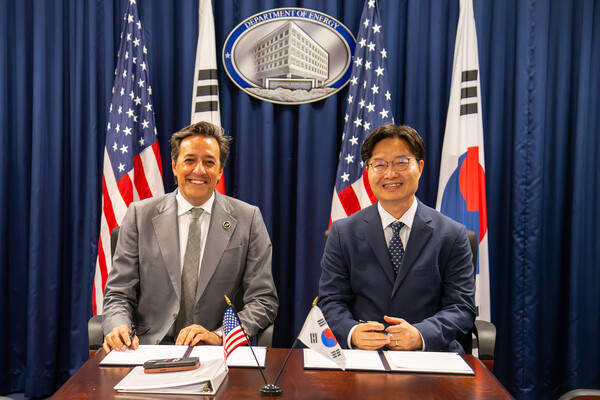
On Aug. 27 in Washington, Koo met Dario Gil, U.S. under secretary for science at the Department of Energy, and signed a statement of intent (SOI) on cooperation in nuclear and high-energy physics.
The two countries will identify new areas of cooperation centred on large-scale research infrastructure in nuclear and high-energy physics, including the Electron-Ion Collider (EIC) and the Deep Underground Neutrino Experiment (DUNE). They also agreed to expand cooperation in computational science using AI-enabled high-performance computing and quantum computing.
They will also promote researcher exchanges, training for graduate students and early-career researchers, and sharing research know-how. The two sides plan to set up a bilateral quantum joint cooperation committee to implement the SOI.
Koo and Gil also discussed potential cooperation in the use of AI in scientific research, known as "AI for Science". On research security, they agreed on the importance of a science and technology security system and shared the two countries' policy directions.
Earlier, Koo met officials from the White House Office of Science and Technology Policy (OSTP) and the State Department on Aug. 25 and 26 to review implementation of the South Korea-U.S. Technology Prosperity Declaration (TPD). He discussed follow-up cooperation measures for the TPD with Ethan Klein, deputy director of the White House OSTP and U.S. chief technology officer (CTO). With the State Department, which oversees coordination of TPD working groups, he shared updates on their progress.
South Korea and the United States signed the TPD in October last year and launched working groups in February to implement it.
A hub was also opened in the United States to support commercialisation of advanced bio technologies from South Korean research institutes. Koo attended the opening ceremony for "G-KIC-NST" held in Kendall Square in Boston on Aug. 28. G-KIC-NST supports network-building among South Korean research institutes and local bio companies, research institutes and venture capital firms.
Koo also met Korean scientists in the United States, heard about U.S. trends in bio technology and industry and the status of research and development support, and discussed cooperation measures between South Korea and the United States.
Koo said, "South Korea and the United States are expanding cooperation in science and technology based on a strong alliance." He added, "We will deliver cooperation results in key technology fields based on the TPD, and expand cooperation between the two countries based on the statement of intent signed with the Department of Energy."
 Jin-ho Lee
jhlee26@d-today.co.kr
Jin-ho Lee
jhlee26@d-today.co.kr