
[Digital Today reporter Seok Dae-geon (석대건)] The earnings math for South Korea’s three battery makers has grown more complicated. Power shortages created by the expansion of artificial intelligence (AI) data centres have become a new pillar supporting battery demand, making it difficult to forecast results based on electric vehicle sales alone.
As EV demand remains sluggish, the three Korean battery makers’ U.S. production lines are shifting toward energy storage systems (ESS), the industry said on Monday. Hana Securities said U.S. EV battery shipments in June fell 7 percent from a year earlier to 9.4 gigawatt-hours. In the same month, new ESS installations in the United States rose 76 percent to 13.0 gigawatt-hours. While weak EV demand persists, power demand from AI data centres is pulling battery volumes toward ESS.
That means the variables driving earnings forecasts for the three Korean battery makers have changed. A single EV sales curve can no longer explain utilisation rates and results. U.S. EV sales are still falling at a double-digit rate, and the demand slowdown has not been resolved. Data centre power demand, grid efficiency and energy security have also emerged as separate pillars creating battery demand.
By company, the drop in EV shipments was larger than the market average. SNE Research said that in the U.S. market in June, LG Energy Solution shipped 1.5 gigawatt-hours, down 42 percent. SK On posted 0.6 gigawatt-hours, down 39 percent, and Samsung SDI shipped 0.3 gigawatt-hours, down 69 percent. That contrasts with Panasonic, which held a 66 percent share of the U.S. market and increased shipments 33 percent to 5.3 gigawatt-hours. In the same month, global EV battery shipments rose 30 percent to 135.6 gigawatt-hours.
Numbers for ESS pointed in a different direction. Based on figures from research firm Rho Motion, global new ESS installations in June rose 51 percent to 50.8 gigawatt-hours. Of that, the United States accounted for 13.0 gigawatt-hours, and grid ESS installations increased 81 percent to 12.0 gigawatt-hours. U.S. installations in the first half totalled 34.5 gigawatt-hours, up 29 percent. Global installations over the same period rose 41 percent to 182.2 gigawatt-hours. June installations in Europe rose 249 percent to 4.2 gigawatt-hours, while China fell 15 percent to 12.7 gigawatt-hours.
There is no sign of a rebound in EV demand itself. By counts from U.S. automotive publication WardsAuto, U.S. EV sales in July fell 32.3 percent to 93,212 vehicles. Battery electric vehicles (BEVs) fell 37.2 percent to 73,443. Cumulative sales for the year fell 16.2 percent to 641,411.
The change reflects a shift in the logic supporting ESS demand. Hana Securities said that until 2025, the growth narrative for ESS was tied to decarbonisation themes linked to clean energy and solar power. Now, the starting point is power shortages created by the expansion of data centres. Demand is rising for solar installations, which have shorter construction periods, with ESS following alongside. AI data centres in particular have characteristics in which power demand plunges over a short time and then spikes again, and the firm viewed a buffer between supply and demand as necessary.
Policy changes also point in the same direction. PJM, a power utility operator in the eastern United States, is pushing a plan under which new data centres of 50 megawatts or more that fail to secure their own generation or separate power sources would have power cut before regular customers when supply is short. The measure increases incentives for data centre operators to install their own generation and storage facilities.
Data centre power shortages, grid efficiency and energy security emerge as separate pillars
In line with market changes, Korean companies are also shifting facilities and funds toward ESS. Samsung SDI sold part of its stake in Samsung Display for 4.45 trillion won. In a filing, it said the reason for the sale was "securing investment funds and improving the financial structure", and the industry sees the proceeds as likely to be used to expand ESS production capacity. Hana Securities analysed that, combined with factory sites secured through the dissolution of its joint venture with General Motors (GM), the funds are highly likely to lead to an expansion of at least 20 gigawatt-hours of ESS lithium iron phosphate (LFP) production capacity.
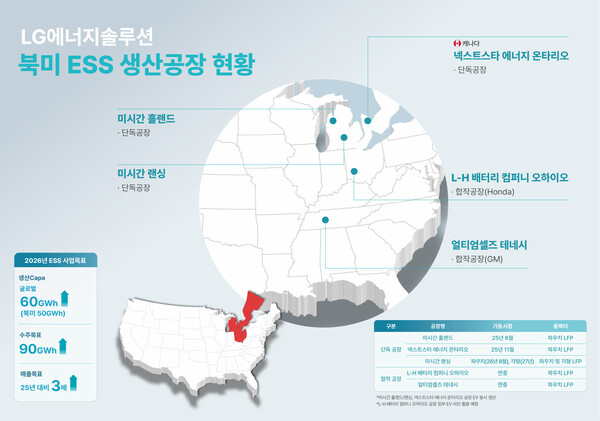
LG Energy Solution is also expanding its ESS business to respond to slowing EV demand in North America, while reviewing a plan to supply batteries for drones and unmanned weapons systems to the U.S. government and major defence contractors. Even so, the shift in secondary battery demand has burdens. In the European market, the combined share of the three Korean companies fell to 30 percent in the first half of this year, from 55 percent in 2023, 45 percent in 2024, 34 percent in 2025. How much of that gap they can fill will be key.
Most ESS volumes in North America are currently based on LFP, while Korean companies have expanded production capacity centred on high-nickel ternary batteries. How quickly they can deliver mass production results in LFP is expected to determine leadership in the ESS shift in the secondary battery market. An industry official said, "News of ESS-related orders will continue," and added, "Even as the EV demand slowdown persists, it has become impossible to narrow the outlook for the three companies to a single sales curve."
 Seok Dae-geon
d2dg@d-today.co.kr
Seok Dae-geon
d2dg@d-today.co.kr