
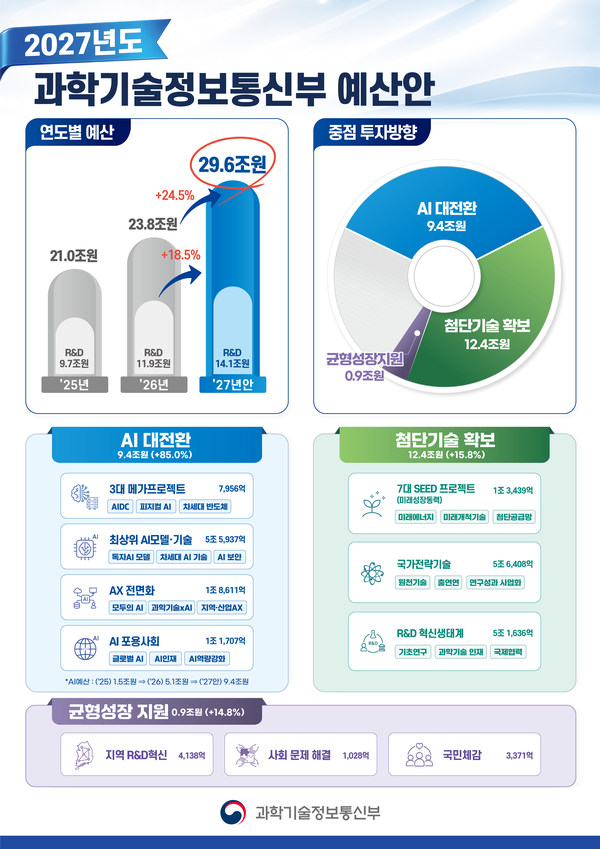
South Korea’s Ministry of Science and ICT has drawn up a 2027 budget proposal worth 29.6 trillion won, up 24.5 percent from this year. The AI budget will rise 84.3 percent to 9.4 trillion won, and the ministry will begin full-scale investment in strategic technologies such as semiconductors, physical AI and AI data centres (AIDC).
The government approved the 2027 budget proposal at a Cabinet meeting on Monday. The ministry’s proposed budget totals 29.65 trillion won, up 5.83 trillion won, or 24.5 percent, from this year’s supplementary budget. R&D spending will rise 18.5 percent to 14.1 trillion won and AI spending will increase 84.3 percent to 9.4 trillion won.
The ministry said it was the first practical budget proposal that the current government led through the entire budget process to put state-policy achievements into full gear. It said it drew up a record-high AI and science and technology budget to strengthen the country’s future potential, based on fiscal room secured through high-intensity spending restructuring.
The ministry’s budget for next year will focus investment on accelerating a major AI transformation, securing NEXT AI and advanced technologies, and supporting balanced growth based on science, technology and digital foundations.
In the “accelerating a major AI transformation” area, the budget will expand to 9.42 trillion won from 5.09 trillion won this year. It will allocate 795.6 billion won to three mega projects covering semiconductors, physical AI and AIDC. In the AIDC area, it will build a 10-megawatt testbed to support verification and commercialisation of domestic solutions. It will newly allocate 87.8 billion won to build an AIDC cluster and foster the industry, and 115.5 billion won for development and advancement of materials, parts and equipment and cloud technologies.
To expand physical AI, the ministry will secure real and synthetic data and strengthen development of a general-purpose physical AI foundation model and field demonstrations in industry. It newly allocated 40 billion won to build a physical AI training centre, 55 billion won to develop core technologies, and 26 billion won for demonstrations and expansion in logistics at the Postal Service.
It will pursue a project to apply domestically made AI semiconductors directly to products and services of local companies to verify commercialisation potential. It will invest 90 billion won to secure a K-AI semiconductor full-stack reference and 20 billion won to develop next-generation core source technologies.
It will invest 5.59 trillion won to secure top-tier AI models and technologies. The budget to expand graphics processing units (GPUs) for developing independent AI models will rise to 3.85 trillion won from 2.08 trillion won this year. Based on this, it plans to add 10,000 Nvidia Vera Rubin-class GPUs. It set 800 billion won for a project to strengthen data competitiveness for developing frontier-level AI, sharply up from 30 billion won last year.
It will allocate 1.86 trillion won for AI services and use, including “AI for Everyone.” It set a new 250 billion won budget to support universal use of an AI service for all citizens. For the AI for Everyone project, it plans to support 2,000 GPUs. The ministry said this was enough to accommodate 10 million daily users. The budget for regional AI transformation (AX), 추진 in four major regions including Daegu-Gyeongbuk, the southwest, Jeonbuk and the southeast, will expand to 334.5 billion won from 177 billion won this year.
It will allocate 1.17 trillion won for an inclusive AI society. Working with major international organisations, it will create a “global AI hub” in South Korea to address global issues such as climate and food. To innovate university AI education, it will expand support for AI-focused universities. It will also establish new AX graduate schools based on industry-academia cooperation. It plans to expand the AI for Everyone competition to spread a culture of AI use among the public.
It allocated 12.38 trillion won for the “NEXT AI and securing advanced technologies” area. Of this, the budget for the “seven SEED projects” covering quantum, advanced bio and aerospace will rise to 1.34 trillion won next year from 861.6 billion won this year. It will support securing future technologies such as development of a domestic quantum computer, an AI-based autonomous drug-discovery lab, a brain-computer interface (BCI) and low-Earth orbit satellite communications.
It will also expand support for basic research and science and technology talent. It will increase the number of individual basic research projects to 18,000 next year from 15,300 this year, and expand the related budget to 2.44 trillion won. It will increase the number of science and engineering scholarship students to 5,140 next year from 2,920 this year, and expand the number of recipients eligible for support for national science and technology workers.
It will also increase investment in regional science and technology innovation and solving social problems. It will allocate 853.7 billion won for the “supporting balanced growth based on science, technology and digital foundations” area. It will newly allocate 151.2 billion won to a “four hubs and three specialised areas science and technology innovation support” programme that includes region-led R&D, and strengthen support for technology development in areas closely tied to daily life such as disasters, drugs, deepfakes and public safety.
 Jin-ho Lee
jhlee26@d-today.co.kr
Jin-ho Lee
jhlee26@d-today.co.kr