
South Korea's Ministry of Science and ICT said on Monday it will designate Seoul, Jeonnam-Gwangju, and Busan-Ulsan-Gyeongnam as quantum clusters after deliberation and approval by the Quantum Strategy Committee.
The designation is intended to link regional industrial bases with quantum technologies to commercialise research outcomes and support corporate growth. The government is pursuing industrialisation policy after selecting quantum as a next-generation frontier field among its seven future growth engines known as the "7 SEED".
The ministry launched a public call from April aiming to designate three clusters. Seven regional consortiums applied, and the final sites were selected after reviews by an expert panel, consultations with relevant ministries, and on-site inspections.
A ministry official explained that the assessment focused on the link between each region’s chosen quantum-technology field and its specialised industries, as well as corporate demand and commercialisation potential.
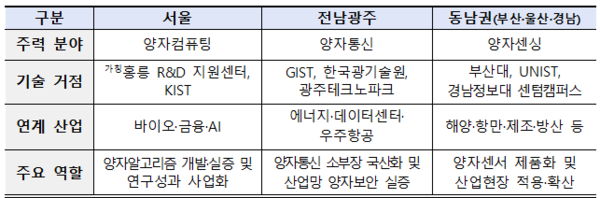
The Seoul quantum computing cluster will link quantum computing with industrial demand in areas such as bio, finance and AI, based on research, corporate and investment capabilities concentrated in the Seoul metropolitan area. It will support activities from quantum algorithm development to device packaging and product development, and will push forward quantum transformation (QX) projects aimed at solving industrial challenges, as well as technology start-ups, investment and talent development.
The Jeonnam-Gwangju quantum communications cluster will foster an ecosystem for quantum communications materials, parts and equipment by leveraging the region’s optical communications and optical device industrial base. It will build a testbed network linked to regional industries such as energy, AI and aerospace, and support quantum communications demonstrations, companies’ quantum transformation and specialist training.
The Busan-Ulsan-Gyeongnam southeast region quantum sensing cluster will bring together manufacturing foundations and quantum sensing research and manufacturing capabilities. It will support quantum sensor manufacturing, packaging, testing and certification, and on-site demonstrations, and will seek to create use cases linked to regional specialised industries such as maritime, ports, manufacturing and defence.
The government will identify regional use cases centred on QX research and development linked to demand-side companies and also support technology transfer and commercialisation of R&D outcomes. It will also establish cooperation among clusters and a performance management system. The central and local governments will draw up region-by-region execution plans within this year and will begin pushing related projects in earnest from next year.
Bae Kyung-hoon (배경훈), vice chair of the Quantum Strategy Committee and deputy prime minister as well as science minister, said quantum technology is a key strategic technology directly tied to national security. He said the government will develop quantum clusters into a representative model of "real growth" that creates new markets.
 Jin-ho Lee
jhlee26@d-today.co.kr
Jin-ho Lee
jhlee26@d-today.co.kr