
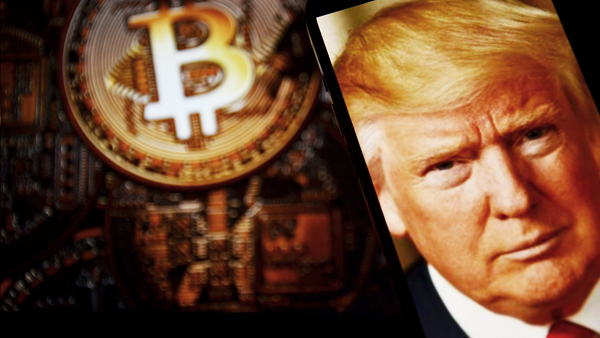
An analysis said bitcoin may not necessarily face headwinds even if the Democratic Party returns to power in the United States. It argued that even if Democrats take a tough regulatory line on the broader crypto sector, bitcoin should be viewed separately from other digital assets.
Bitcoin Magazine reported on Aug. 26 that Matthew Sigel, head of digital asset research at VanEck, said in a CNBC interview that bitcoin could show a resilient trend even under Democratic rule.
Sigel stressed that bitcoin itself should be viewed separately from the trend of Democrats in U.S. politics being grouped into an anti-crypto camp. He also assessed former President Joe Biden as not being hostile to bitcoin itself, saying, "Biden was actually okay with bitcoin."
He added, "If Democrats return to power, the side where problems could arise is the rest of crypto." That means a Democratic return could weigh more on the regulatory environment for other digital assets such as altcoins than on bitcoin.
The remarks came as Republicans have criticized Democrats as an anti-crypto force. During the Biden administration, U.S. regulators filed multiple lawsuits against digital asset companies, putting strong pressure on the industry. Sigel, however, drew a line, saying that such a regulatory stance does not apply equally to bitcoin and other tokens.
He said a stronger progressive tilt within the Democratic Party could instead increase the chance that bitcoin's decentralisation and scarcity are highlighted. Citing New York City, he said, "Many people are reminded why there is a need for the value of an asset that is decentralised, scarce and cannot be printed."
Recent bitcoin price moves are also drawing attention as they align with developments in U.S. politics. President Donald Trump has put support for the digital asset industry at the centre of his key pledges and has also issued pro-crypto executive orders, including a strategic bitcoin reserve.
Bitcoin surged after the 2024 election and set a new record high last year. It showed a sluggish trend for several months in 2026, but has recently resumed gains after Trump urged Congress to pass the CLARITY bill, which includes a regulatory framework for the digital asset market.
Bitcoin has risen about 24 percent over the past seven days and this week briefly climbed to $81,160. It later gave back part of the gains and is now trading at around $78,438. The market cites expectations for progress on legislation that could reduce regulatory uncertainty as a factor behind the recent rebound.
The CLARITY bill classifies digital assets into securities, commodities and payment stablecoins, and sets which regulator will oversee each asset. Pro-crypto lawmakers wanted Congress to pass the bill before the August recess, but a vote was pushed to September after Democrats opposed the latest draft.
Some Republican senators criticized Democrats for intentionally delaying passage of the bill. An analysis also said it is excessive to view the entire Democratic Party as a single anti-crypto force.
Faryar Shirzad, Coinbase's chief policy officer, said in July that crypto "could be the most bipartisan issue in Washington." He also assessed that much of the opposition behind the CLARITY bill delay stemmed from a generational gap. Younger Democratic lawmakers who understand technology also understand the need to adapt to changes in the financial system and new technology, he said.
As a result, market attention is focused on whether a Democratic return would have a bigger impact on altcoin regulation than on bitcoin itself. At the same time, the CLARITY bill vote, pushed to September, is also cited as a key variable in whether it leads to a restructuring of the regulatory framework.
Depending on how the U.S. political landscape and the direction of digital asset regulation move, the market environment for bitcoin and altcoins is increasingly likely to diverge.
 Jinju Hong
hongjj@d-today.co.kr
Jinju Hong
hongjj@d-today.co.kr