
South Korea’s homegrown Nuriho (KSLV-II) rocket has succeeded in its fifth launch. It flew carrying a record 15 satellites and separated all 5 ultra-small cluster satellites and 10 CubeSats.
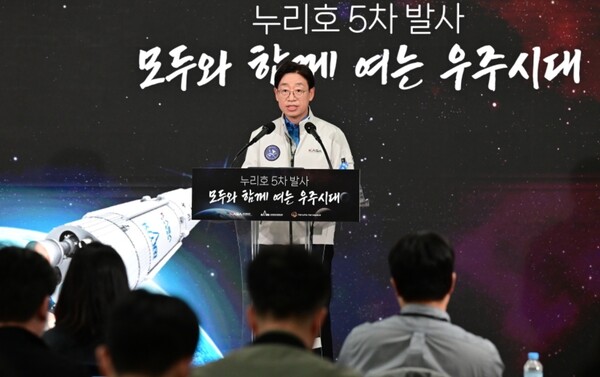
Korea Aerospace Administration Administrator Tae-seok Oh (오태석) announced the success of Nuriho Flight 5 at a launch results briefing held at 2 p.m. on Monday at the Naro Space Center in Goheung. Nuriho lifted off from the second launch pad at 12:25 p.m. and flew for about 20 minutes.
After liftoff, the first stage, the fairing that protects the satellites, and the second stage separated in sequence. The third-stage engine then continued ascent, reached an altitude of about 575 km and began satellite separation procedures.
The first primary payload, NeonSat-2, separated about 13 minutes and 30 seconds after liftoff. Satellites 3 through 6 then separated one by one at 35 to 40-second intervals. After separating all 5 NeonSats, it released the 10 CubeSats in pairs at about 10-second intervals.
The final CubeSat separated about 17 minutes and 15 seconds after liftoff. The upper section of Nuriho carried out follow-up procedures to avoid collisions with the satellites, then completed the flight about 19 minutes and 45 seconds after liftoff.
The key to this launch was sequentially deploying 5 NeonSats, which carry out the same observation mission, with a single launch. To prevent collisions among the satellites, the third stage changed its attitude and separated them in different directions. It also newly applied a low-shock satellite separation device to reduce impacts during separation.
NeonSat will take ground images to be used for national security and responses to disasters such as wildfires and floods. The CubeSats launched together will carry out missions including verifying the space-environment performance of domestically made materials and components, observing the space environment and monitoring ocean currents.
The Korea Aerospace Administration plans to launch 5 additional NeonSats on Nuriho’s sixth launch in 2027 to build a constellation operations system of 10 satellites. Once completed, the constellation will be able to image the Korean Peninsula at least 3 times a day.
After the launch vehicle mission is completed, initial communications with each satellite and checks on their status will follow. Whether the satellites separated normally and whether they operate normally in orbit must be confirmed separately. Initial communications results for NeonSat, the primary payload, are expected to be announced at around 4:30 p.m. on Monday.
 Yoonseo Lee
yslee@d-today.co.kr
Yoonseo Lee
yslee@d-today.co.kr