
LG Display is pushing a plan to apply an organic light-emitting diode (OLED) pixel-forming process that does not use a fine metal mask (FMM) to IT panels. It is based on the view that it is hard to scale up substrates with the existing FMM method and not easy to lower the price of IT OLEDs. The company plans to use existing facilities to reduce the investment burden and enter the IT market first.
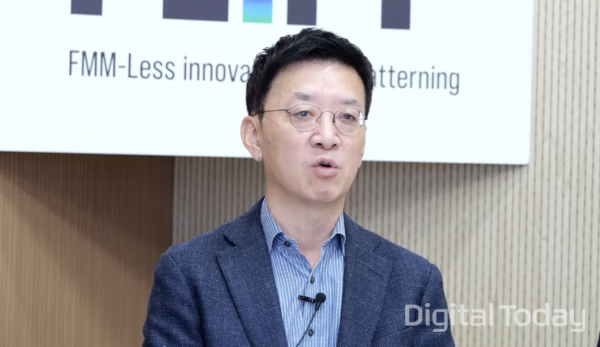
LG Display held an online tech seminar on Oct. 8 and unveiled its in-house OLED process technology, FLiPP, now under development. FLiPP is a technology LG Display first unveiled earlier at the IMID display exhibition. LG Display Chief Technology Officer Young-seok Choi (최영석) said, "It was a concern for all display makers that it is hard to solve with the existing FMM method," and added, "We will open up the IT market through FLiPP."
FMM, the existing process, is a thin metal plate with tiny holes. It blocks everything else so red, green and blue (RGB) pixel materials are deposited only in designated positions. As the substrate gets bigger, the metal plate sags in the middle and it becomes harder to match the gap with the glass.
Because of this, 8th-generation FMM lines go through a half-cut process that cuts the master glass substrate in half. When screen size or resolution changes, the mask must also be remade. Defects caused by sagging masks or contamination are also recurring problems with the FMM method. LG Display explained that costs for mask production and management and for defects amount to hundreds of millions of won a year per model.
By contrast, FLiPP is a process that makes pixels using photolithography technology without FMM. It deposits organic light-emitting materials across the entire substrate, then applies a protective layer through an encapsulation process to parts to be retained and removes the rest with ultraviolet light. LG Display said it repeats this process in sequence for each of the red, green and blue colors to complete RGB pixels.
LG Display executive director Heung-ryeol Cho (조흥렬), who is in charge of next-generation displays, said, "It is a method that combines photo patterning with open mask (OMM) deposition used for large OLEDs." Because OLED materials lose performance when exposed to moisture or chemicals, protective-layer technology is a prerequisite for the process. LG Display cited its experience mass-producing OMM for TV white OLED (WOLED) and FMM for smartphone OLEDs as the foundation for the process.
According to LG Display, panels that apply FLiPP increase aperture ratio to 65 percent from 42 percent under the FMM method. Aperture ratio refers to the portion of the total display area occupied by pixels. LG Display stressed that removing FMM reduces spacing between pixels, and said the larger aperture ratio can be used to improve brightness or lifespan and reduce power consumption.
In production, it uses the 8th-generation master glass substrate without cutting it. Without cutting the master, more panels can be made from one sheet of glass. Based on a 23.5-inch panel, LG Display said edge-trimming efficiency rises to more than 93 percent from about 75 percent under the FMM method.
LG Display plans to apply the process to IT panels first. Choi cited laptops and monitors with customer demand as the first targets. Smartphone OLEDs and WOLED are already in mass production on existing facilities, so there is no need at present to switch them to FLiPP, he said. The company aims to improve line operating efficiency by producing WOLED and FLiPP in parallel.
Over the medium to long term, the company plans to expand it to other product groups depending on customers and the market. It also plans to use equipment from existing lines. Choi said, "Even with a relatively small cost compared with new investment in 8.6th-generation equipment, we can enjoy a big effect."
Still, the exact timing for applying it to mass production is undecided. The company said it will decide after consulting customers. Work also remains to separate equipment among existing facilities into what can be used as is, what should be modified and what must be newly purchased. Choi said, "Even after FLiPP enters mass production, FMM, OMM and FLiPP will coexist, and competitive technologies will be selected by product." LG Display's plan to cut investment by using existing facilities is expected to be detailed depending on the results of this classification work and whether customers are finalised.
 Dae-geon Seok
d2dg@d-today.co.kr
Dae-geon Seok
d2dg@d-today.co.kr