
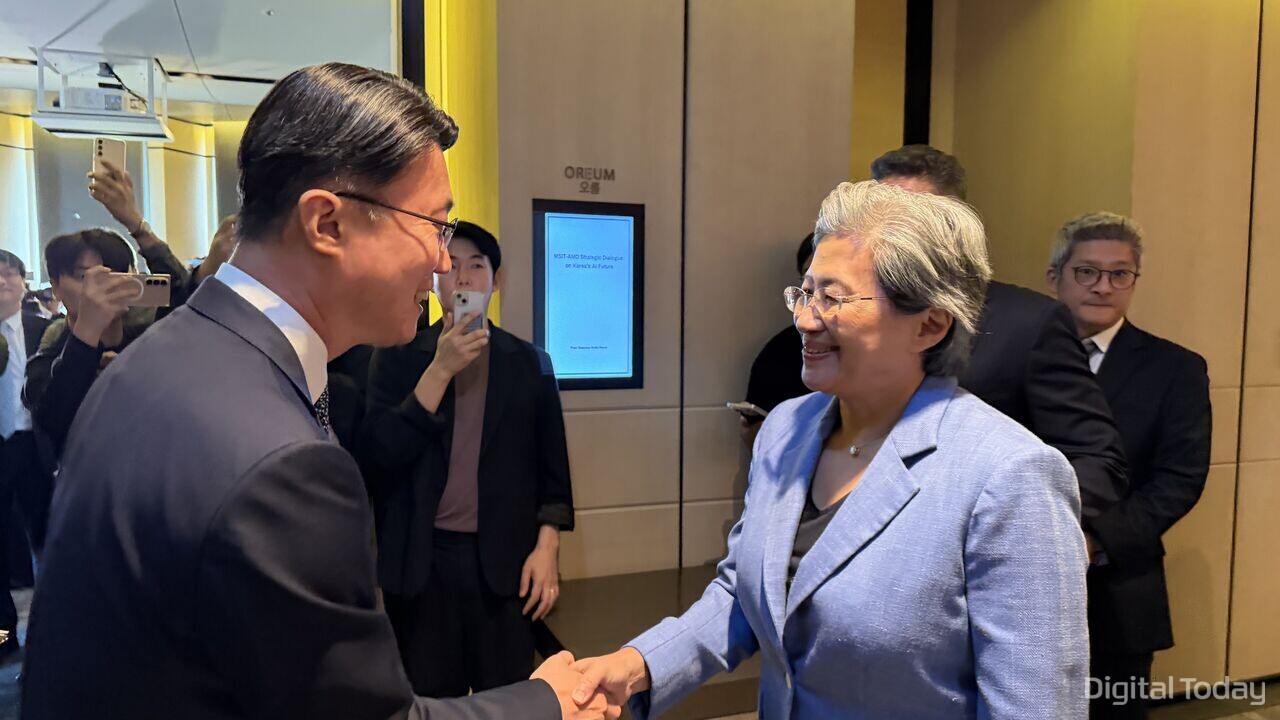
AMD Chair Lisa Su met South Korean AI chip companies as the U.S. chipmaker moves to expand cooperation based on an open AI ecosystem. Attention is on whether South Korea can diversify AI infrastructure concentrated on Nvidia graphics processing units (GPUs) into AMD GPUs and locally made neural processing units (NPUs), and in the long term expand into “full-stack sovereign AI” securing domestic capabilities from models to semiconductors, software and infrastructure.
The Ministry of Science and ICT and AMD on Oct. 7 held an “AI semiconductor and startup roundtable” at the Four Seasons Hotel in Seoul’s Jongno district and discussed cooperation to build a heterogeneous computing ecosystem with South Korean AI companies.
Thirteen South Korean companies across AI infrastructure attended, spanning NPUs to software, cloud and AI models, including FuriosaAI, HyperAccel, DeepX, Mobilint, Mangoboost, Panmnesia, Dinoticia, Moreh, Nota AI, Rableup, FADU, Elice Group and Upstage.
Ryu Je-myeong (류제명), second vice minister of science and ICT, said in opening remarks that as AI shifts its center of gravity toward inference, the importance of heterogeneous AI computing is growing. He said it is becoming more important to flexibly use various computing resources depending on service type and purpose, rather than relying on a single semiconductor.
He added that as AMD is expanding an open computing ecosystem based on open source and standards, new opportunities for cooperation could open for South Korean companies.
The ministry and AMD also discussed building a heterogeneous computing infrastructure combining AMD central processing units (CPUs) and GPUs with South Korean AI semiconductors, and developing it into a reference model that can be used in global markets.
Su also put an open ecosystem and collaboration forward as AMD’s core principles.
Su said there has been a great deal of progress in AI over the past 6 months and that AMD’s principles are always rooted in an open ecosystem and collaboration. She said AMD is already working with some companies present and hopes to deepen cooperation through discussions on the day.
She also said she believes an open ecosystem is needed to advance the AI frontier and expand AI adoption worldwide, and that she will look at South Korean startups’ technologies and areas where AMD can support cooperation.
◆ From “it has to be Nvidia” to heterogeneous computing
The industry expects AMD’s expanded cooperation in South Korea could go beyond simply replacing Nvidia GPUs with AMD GPUs.
As AI services rapidly shift from training to large-scale inference, it is becoming more important to combine different accelerators such as GPUs and NPUs by workload rather than processing all computation on a single high-performance GPU.
A new market could also open for South Korean NPU companies. Most domestic AI chipmakers currently focus on inference rather than pretraining of very large models, but as agent AI spreads and inference volume increases, inference infrastructure itself is scaling up, widening areas of use.
Rableup CEO Shin Jeong-gyu (신정규) met with reporters ahead of the meeting and said the AI market is expanding far faster than companies like Nvidia or AMD can cover. He said as each company makes choices and focuses, gaps inevitably emerge in the market.
He said that as high-performance GPUs move to ultra-large and high-value markets, replacement demand for GPUs already installed in existing data centres, or inference markets where power efficiency matters, could become an opportunity for South Korean NPUs.
Shin said replacement demand will emerge from next year even at sites that used GPUs such as the H100. He said that will clearly create an opportunity for NPU companies that can match that level of performance. He also said expanding use cases such as coding, agent AI and mid-sized model orchestration, and the growing number of companies seeking to build edge infrastructure for data security reasons, could increase demand for South Korean NPUs.
◆ Beyond inference to training... can “full-stack sovereign AI” work
The key question is how far the role of South Korean AI semiconductors can be expanded.
Most NPUs commercialised by South Korean companies are currently focused on inference. Pretraining of very large AI models relies in effect on an Nvidia-centred GPU ecosystem, so to implement “full-stack sovereign AI” spanning models and computing infrastructure, the gap of training chips must be filled.
Pretraining is the process of building an AI model’s basic capabilities from scratch using large-scale data and requires massive computing resources. By contrast, post-training is the process of advancing an already pretrained model for specific purposes through fine-tuning or reinforcement learning (RL). It requires a relatively smaller scale of computation than pretraining, making it a realistic starting point for South Korean NPUs to enter training beyond inference.
The industry is discussing a plan to first increase use of South Korean NPUs in inference and post-training and then gradually expand to pretraining.
FuriosaAI CEO Baek Jun-ho (백준호) said South Korea is one of the few countries in the world that can do semiconductors as a full stack. He said he believes it is fundamentally possible. He said inference currently accounts for a large share of the data centre market, so the focus is on inference first, but technically it can be expanded into pretraining later.
Baek said as inference using large-scale clusters increases, technology and infrastructure secured in inference NPUs can become a basis for later expansion into training.
He also proposed using the government’s frontier AI model development project, which is being promoted with 4.7 trillion won next year, as a test bed for South Korean NPUs. He said the government should create opportunities to reduce trial and error in early adoption and to secure references used in actual AI model development.
Baek stressed that the government needs to serve as a test bed because there may be trial and error when attempting training with South Korean NPUs for the first time. He outlined an approach of developing models around GPUs but starting to use South Korean NPUs in post-training, then gradually expanding to pretraining depending on results.
◆ Government also starts “full-stack” push, to build large-scale references for South Korean NPUs
The government will also move to build large-scale references next year so South Korean NPUs can be used in actual AI infrastructure. It will move beyond chip-level adoption and demonstrations to verify performance and interoperability by bundling CPUs, GPUs, NPUs, Compute Express Link (CXL) and software into a single system.
Lee Do-gyu (이도규), head of the ICT Policy Office at the Ministry of Science and ICT, said at a background briefing that many cases in the past involved supplying South Korean NPUs at the chip level, limiting global expansion. He said the ministry plans a large-scale reference-building project next year that can properly validate a full stack including CPUs, GPUs, CXL and software.
The project will be promoted through open calls for multiple tasks rather than a single task, with companies forming consortia to participate according to their technologies and services.
The frontier AI model development project also left open the possibility of using South Korean NPUs. Asked about securing references by using domestic NPUs for post-training or inference, Lee said he understands that it is naturally being considered and 추진 at the ministry level. Specific methods of use and proportions have not yet been decided.
Cooperation with AMD also aligns with this direction. The government aims to combine AMD CPUs and GPUs with South Korean NPUs to raise cost and power efficiency while also building a supporting software ecosystem.
Lee stressed that it is important to optimise CPUs, GPUs and NPUs to deliver high performance at minimal cost and to have a supporting software environment. He said the government aims to support South Korean companies’ participation in AMD’s open ecosystem so they can grow into global partners.
 Seulgi Son
sageson@d-today.co.kr
Seulgi Son
sageson@d-today.co.kr