
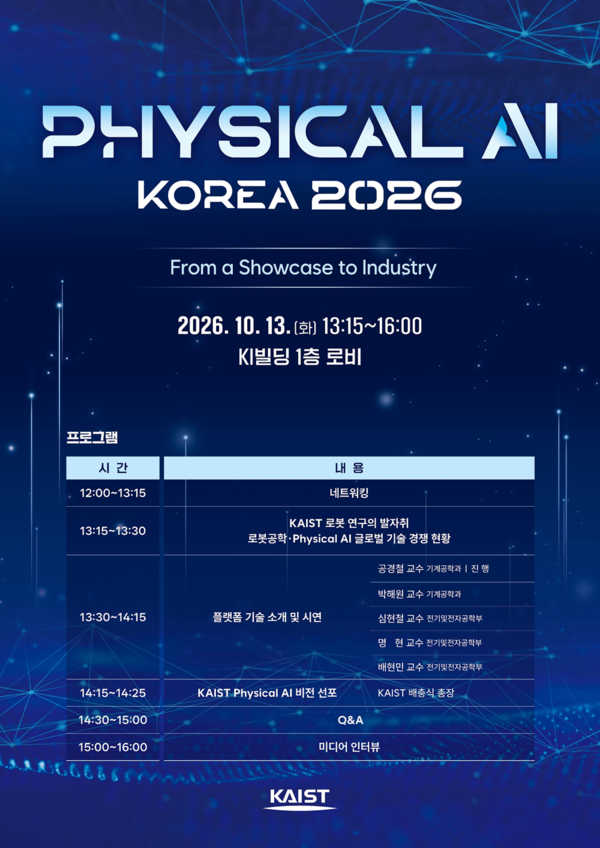
[DigitalToday reporter Hwang Chi-gyu] KAIST will hold Physical AI Korea 2026 on Oct. 13 at the KI Building on its main campus in Daejeon. It will unveil physical AI platform technology that can be used by various companies, along with research, education and startup strategies.
At the event, President Bae Chung-sik (배충식) is set to say: "The key battleground for physical AI is not how humanlike a robot is, but how widely we can implement AI that understands and moves in the real world." He is also expected to say: "Based on strong fundamentals, KAIST will build core technologies needed for sensing and movement, and for cooperation among multiple machines, so they can be used in various robots and industries. We will also cultivate the talent and companies that will lead this."
Bae will wear a wearable robot developed by a research team led by Professor Kong Kyung-chul (공경철) and go on stage on the day of the event. He is set to demonstrate a physical AI use case in which the robot goes beyond helping human movement by analysing health information and informing the wearer based on data obtained from the wearer's movements.
According to KAIST, the wearable robot developed by Kong's research team has mainly been studied as a technology to support rehabilitation treatment and assist walking for people with disabilities. Adding physical AI technology could allow it to be used not only as a walking aid but also as sensor equipment that monitors human movement and health conditions.
KAIST plans to disclose its physical AI technology framework and the areas it will focus on next by linking research capabilities accumulated in robotics, artificial intelligence, sensors, actuators and data.
KAIST is focusing on securing platform technologies that can be commonly used across multiple robots and industries, rather than concentrating its capabilities on perfecting a single robot.
It presented the following as core technologies: actuators that move robots precisely; technology that measures and processes physical data from the real world; data centre technology that manages and operates large-scale data; motor intelligence that creates movement on its own; and sensory intelligence that understands the surrounding environment and people.
KAIST is also continuing cooperation on physical AI research that understands human movement. Kim Jeong (김정) and Kong serve as co-directors at the Human Physical Intelligence Research Center. KAIST is pursuing related research through cooperation with the NVIDIA AI Technology Center (NVAITC).
KAIST also plans to build an ecosystem that connects technology development with talent training, startups and industrial expansion.
 Hwang Chi-gyu
delight@d-today.co.kr
Hwang Chi-gyu
delight@d-today.co.kr