
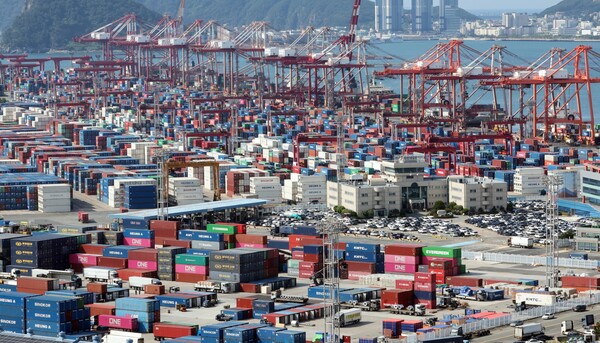
Exports surged, led by semiconductors, and South Korea's current account posted a $46.11 billion surplus in August. The goods balance surplus topped $46.8 billion, while the services balance stayed in deficit, led by travel.
The Bank of Korea said on Wednesday in its preliminary balance of payments data for August 2026 that the current account surplus totalled $46.11 billion in August. The cumulative surplus for January to August was $279.2 billion.
The goods balance drove the current account surplus. The goods balance posted a $46.81 billion surplus in August, widening from $40.43 billion a month earlier. Exports rose 82.1 percent from a year earlier to $104.8 billion on a balance of payments basis, while imports rose 23.8 percent to $57.99 billion.
Exports also showed a strong increase on a customs clearance basis. Exports rose 68.7 percent from a year earlier to $98.28 billion in August. Semiconductor exports surged 206.1 percent to $46.83 billion, and information and communications equipment rose 137.4 percent to $9.26 billion. Passenger car exports fell 30.1 percent, and ships dropped 45.2 percent.
By region, export growth accelerated mainly to the United States, China and Southeast Asia. Exports to the United States rose 89.2 percent from a year earlier, China rose 119.4 percent and Southeast Asia climbed 91.7 percent. Exports to the European Union also increased, but the growth rate slowed from the previous month to 14.6 percent.
The services balance showed a $1.68 billion deficit. The travel balance recorded a $770 million deficit and other business services showed an $830 million deficit. The overall services deficit narrowed from $1.97 billion the previous month.
The primary income balance posted a $1.92 billion surplus, helped by dividend and interest income. Dividend income recorded an $1.18 billion surplus and interest income showed a $1.01 billion surplus. The secondary income balance was a $940 million deficit.
In the financial account, net assets increased by $40.23 billion. Residents' overseas portfolio investment rose $16.6 billion, led by stocks, while foreigners' domestic portfolio investment fell $4.85 billion, led by bonds. Residents' overseas direct investment increased $6.22 billion, and foreigners' domestic direct investment fell $1.61 billion.
 Ji-young Lee
ljy@d-today.co.kr
Ji-young Lee
ljy@d-today.co.kr