
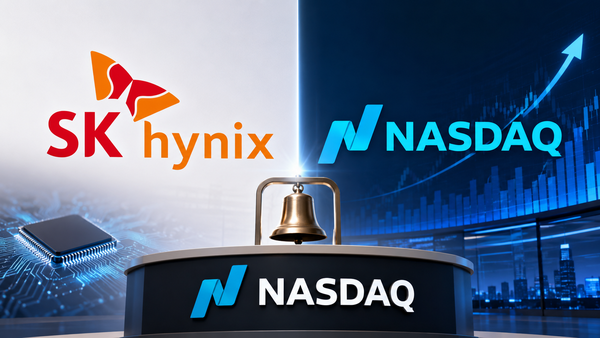
With SK Hynix’s American depositary receipts (ADR) close to a Nasdaq listing, attention is also turning to the possibility of tokenisation. Overseas, tokenised products backed by U.S.-listed shares and exchange-traded funds (ETF) are spreading. That has prompted speculation that SK Hynix ADRs could become a candidate for inclusion on on-chain stock platforms after listing.
According to the financial investment industry on Sunday, SK Hynix ADRs are set to begin trading on Nasdaq in the United States on July 10 local time. SK Hynix plans to newly issue up to 17.79 million common shares, deposit them with an overseas depositary institution, and issue ADRs based on them.
The planned issuance size is up to 4.55 trillion won. However, the final issue price and fundraising amount will be set through bookbuilding for overseas institutional investors. The structure is that 10 ADRs represent one common share, and the underwriters include Bank of America, Citigroup, Goldman Sachs and JPMorgan.
This ADR listing is meaningful in that it expands the route for U.S. investors to invest in SK Hynix in dollars without going through the Korea Exchange.
Overseas digital asset markets have also recently seen rapid growth in tokenised stocks, where tokens are issued using actual stocks or ETFs as collateral and traded on blockchain networks.
Junho Lee (이준호), an analyst at Hana Securities, pointed to tokenised stocks as a major trend in the digital asset market in the second half. Based on real-world asset tokenisation data platform RWA.xyz, transaction volume in tokenised stocks topped $7.5 billion, up more than twofold from May, and about 70 percent of trading was conducted via the Solana chain, it was analysed.
He also said that if SK Hynix ADRs trade on Nasdaq, overseas platforms such as Ondo and xStocks could tokenise them.
xStocks promotes tokenised products backed 1-for-1 by U.S. stocks and ETFs. However, token holders do not have all the rights of actual shareholders. It offers exposure to the underlying asset’s price but does not grant voting rights.
On the regulatory front, differences between U.S. and South Korean approaches are a variable. The U.S. Securities and Exchange Commission (SEC) in January divided tokenised securities into issuer-led and third-party-led types in its explanation.
It also presented a model in which a third party tokenises another issuer’s securities, but said the rights structure may differ from the underlying security and separate risks could arise, such as third-party bankruptcy. The SEC also specified that the explanation does not create new laws or add obligations.
The market is also paying attention to reports that the SEC is preparing “innovation exemption” guidance for tokenised stock trading. Reuters reported that the SEC is reviewing policies in a direction that would allow trading in products that tokenise existing U.S. stocks.
However, Citadel Securities and the Securities Industry and Financial Markets Association (SIFMA), among others, have raised concerns citing investor protection and potential damage to market structure, leaving variables until rules are finalised.
South Korea is placing greater weight on accommodating security tokens (STO) within the framework of the Capital Markets Act and the Act on Electronic Registration of Shares and Bonds. The Financial Services Commission has defined security tokens as the digitalisation of securities under the Capital Markets Act using distributed ledger technology, and has previously said it will apply the same investor protection mechanisms as existing securities.
As a result, even if SK Hynix ADRs are included on overseas on-chain platforms, short-term benefits are more likely to be concentrated first on overseas tokenisation platforms and global digital asset infrastructure companies than on domestic financial firms. That is because South Korea’s regulated system is still prioritising institutionalisation of issuer-centred security tokens over tokenised stocks.
The Korea Capital Market Institute analysed that cross-border crypto asset transactions based on blockchain are expanding in a direction that complements or partially replaces traditional financial infrastructure.
As of 2024, the size of cross-border crypto asset transactions is estimated at about $2.5 trillion, and the share of real-use transactions such as payments and remittances is also growing, centred on stablecoins.
An industry official said, “If SK Hynix ADRs are included in the tokenised stock market, it would be symbolic for a leading domestic semiconductor stock to enter a global on-chain trading network.” The official added, “If domestic systems and infrastructure continue to lag, actual trading and profit opportunities could be formed around overseas platforms.”
 Oh Sang-yup
yub@d-today.co.kr
Oh Sang-yup
yub@d-today.co.kr