
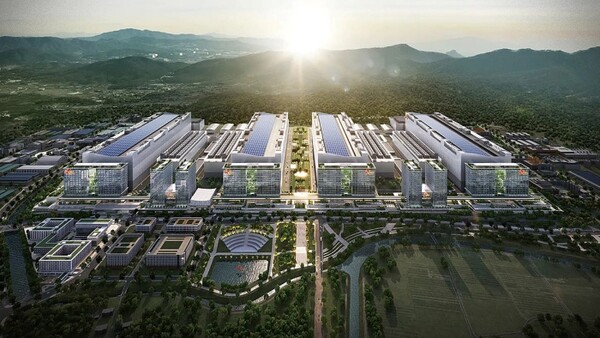
The government, Samsung Electronics and SK Hynix have designated the southwest region as a "second semiconductor cluster" and announced an investment plan worth 800 trillion won, stirring South Korea's semiconductor materials, parts and equipment sector. Expectations are rising for orders for infrastructure equipment tied to new fabs. A spillover effect is also expected across the broader ecosystem through links between innovation hubs for materials, parts and equipment stretching to the southeast and Daegyeong regions.
The government is 추진ing the "three mega projects for a great leap forward" with semiconductors, physical AI and AI data centers as core pillars. In semiconductors, it set out directions including early completion of a production base in the Seoul metropolitan area, building a second production base in the southwest, fostering a packaging hub in the Chungcheong region, and expanding the materials, parts and equipment ecosystem in the southeast and Daegyeong regions. The plan includes 800 trillion won for the southwest and 81 trillion won for the Chungcheong region.
Infrastructure equipment is expected to be the first beneficiary from new fabs in the southwest. Once foundation work is completed, orders will begin for infrastructure facilities needed for semiconductor production, including cleanrooms, vacuum pumps that remove impurities and gas scrubbers that purify harmful gases. Orders are then expected to follow for domestic equipment used in the three major front-end processes that affect semiconductor yield, including photo, etching and deposition. Typically, when a large-company fab is built, hundreds of partner firms expand alongside it, so funds are expected to flow across the value chain from infrastructure to equipment for upstream and downstream processes.
The government presented a structure in which the southwest handles production and the Yeongnam region, including the southeast and Daegyeong regions, supports it from behind as an "innovation hub" for materials, parts and equipment. According to the Ministry of Trade, Industry and Energy, the plan is to stabilize key supply chains by linking the Daegyeong region, where a materials ecosystem has formed around Gumi, with the southeast region, which is emerging as a power semiconductor hub. If a structure is completed in which southwest fabs serve as demand centers and the southeast and Daegyeong regions supply materials and parts, a spillover effect is expected for local economies and the broader domestic materials, parts and equipment industry.
The Yongin area, where sites have already been secured, is expected to benefit relatively quickly. Unlike new site projects that must go through land acquisition and compensation, permits and approvals, and securing power and water, Yongin is undergoing industrial complex plan approval and land acquisition procedures, and that could lead to faster order wins and revenue recognition, analysts say. In the announcement, Samsung Electronics confirmed a plan to bring forward the completion date for its Yongin plant to 2040 from 2047, while SK Hynix confirmed moving its timeline to 2033 from 2045.
Samsung E&A is cited as a gauge of benefits for equipment suppliers. As a significant share of facilities installed in semiconductor fabs are brought in after Samsung E&A plant construction work, its order flow serves as a leading indicator of upstream orders for materials, parts and equipment. With earlier fab starts also pulling forward the timing of orders for infrastructure and front-end process equipment, an expansion in Samsung E&A orders is interpreted as a signal of earlier benefits for the domestic supplier sector. IBK Investment & Securities said Samsung E&A's advanced industry (semiconductor) order guidance is 3 trillion won, but estimated it could exceed 6 trillion won a year due to Samsung Electronics resuming investment and the impact of an early start for Pyeongtaek P5.
◆ Key issue is adoption rate of domestically made materials, parts and equipment
The securities industry also sees the cluster investment, alongside a boom in AI infrastructure investment, as likely to lift supplier earnings and corporate valuations. SK Securities analyzed that equipment orders tied to the operation of new fabs would begin in earnest from 2027. UBS forecast that the front-end process equipment industry would reach about 380 trillion won by 2028, citing capacity expansion by memory manufacturers. Shinhan Investment Corp analyzed that expanded investment and faster process transitions by memory manufacturers would likely increase equipment orders and expand materials usage.
With a second southwest cluster confirmed in addition to the existing Yongin mega cluster, business opportunities for domestic suppliers have broadened. But the key is the adoption rate of domestically made equipment. Ultimately, the scale of actual benefits is expected to depend on how far Samsung Electronics and SK Hynix raise the share of domestic equipment during fab construction. In the industry, there are expectations that if higher localization rates are supported, the self-reliance of the K supplier ecosystem will rise by a step.
An industry official said, "With the creation of a second southwest cluster confirmed in addition to the existing Yongin cluster, a completely new market has opened for domestic supplier companies that had been competing for a limited pie." The official said, "If they actively adopt domestically made equipment in the supply chain, a leap forward for K suppliers will be achieved."
 Daegeon Seok
d2dg@d-today.co.kr
Daegeon Seok
d2dg@d-today.co.kr