
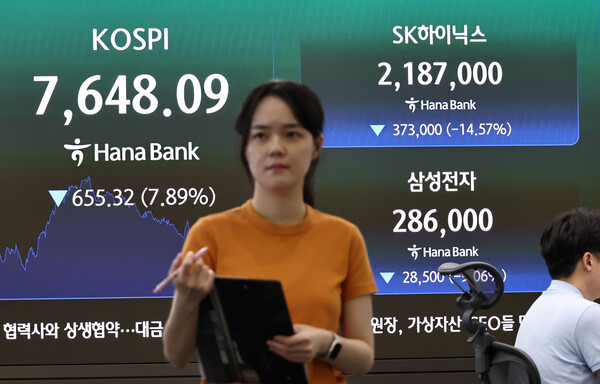
The KOSPI ended down more than 7 percent as a sharp fall in major semiconductor stocks weighed on the market. A sell-side sidecar was triggered on the main board early in the session, and another was activated on the Kosdaq in the afternoon, widening market volatility.
On Thursday, the KOSPI closed down 655.32 points, or 7.89 percent, at 7,648.09. It opened down 370.31 points, or 4.46 percent, at 7,933.10, and slid to the 7,600 level during the session.
In the main board market, individuals were net buyers of 6.2546 trillion won. Foreign investors and institutions were net sellers of 4.3706 trillion won and 2.0716 trillion won, respectively. Institutions switched to net selling with 30 minutes left in the session and dumped shares.
The Korea Exchange triggered a sell-side sidecar in the main board market at 9:07 a.m. on Thursday. Sidecars have been triggered 30 times in the main board market this year, including 15 buy-side and 15 sell-side activations.
Among top stocks by market capitalisation, semiconductor shares tumbled. Samsung Electronics closed at 286,000 won, down 28,500 won, or 9.06 percent, from the previous session. SK Hynix fell 373,000 won, or 14.57 percent, to 2,187,000 won.
SK Square fell 13.20 percent, Samsung Electro-Mechanics dropped 12.65 percent, Hyundai Motor slid 1.13 percent, Samsung Life fell 4.26 percent and Samsung C&T declined 6.34 percent. LG Energy Solution rose 1.72 percent and Samsung Biologics gained 0.72 percent.
The Kosdaq also fell sharply. It closed down 62.63 points, or 6.74 percent, at 866.72. A sell-side sidecar was also triggered in the Kosdaq market at 12:47 p.m.
As of the close, the won-dollar exchange rate stood at 1,556.00 won, up 3.50 won, or 0.23 percent, from the previous session.
The market sees overall investor sentiment in domestic equities as having weakened as the fallout from a sharp fall in U.S. semiconductor shares combined with a rising exchange rate and foreign selling. As declines widened in major chip stocks such as Samsung Electronics and SK Hynix, downward pressure on the KOSPI increased.
 Sangyeop Oh
yub@d-today.co.kr
Sangyeop Oh
yub@d-today.co.kr