
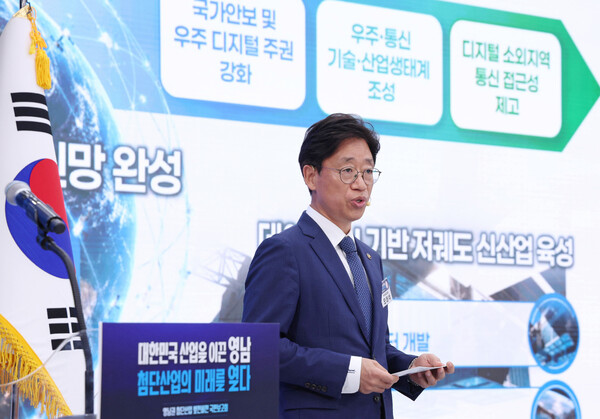
The government will pursue steps including building a Korean low-Earth-orbit satellite communications network, developing a public-private lunar lander and developing reusable launch vehicles, aiming to reach 3 percent of the global aerospace market by 2035. It also decided to bring forward the moon landing timeline and launch a small lunar lander in 2030.
The Korea AeroSpace Administration on July 3 reviewed and approved a "South Korea aerospace industry promotion strategy" at the 5th National Space Committee meeting held at Gyeongsang National University in Jinju, South Gyeongsang Province.
The strategy includes plans to foster the southern coast region as a key base for the aerospace industry and support companies and regions so they can lead industrial growth. The government plans to shift the focus of space development policy from research and development to demand creation. It will also expand support from large-scale systems to materials, parts, equipment and the use of satellite information. It will promote civil-military cooperation and encourage companies in other industries to enter the aerospace market.
Key tasks include building a Korean low-Earth-orbit satellite communications network, launching a public-private lunar lander in 2030, repeat launches of the Nuri rocket and development of reusable launch vehicles, development of an electric-turbine hybrid vertical takeoff and landing aircraft, and creating an aerospace hub centered on Sacheon in South Gyeongsang Province. As part of the K-Moonshot initiative, it will develop an AI-based space data center and build a low-Earth-orbit production platform to support major industries such as AI, communications, pharmaceuticals, new materials and semiconductors so they can grow in space.
◆ Build Korean low-Earth-orbit satellite communications network by 2035
In the satellite sector, the government will build a mass-production system for satellites based on stable public demand. It plans to draw non-space companies into the market to strengthen domestic supply chains for materials and parts and boost manufacturing capabilities. It will also push to establish a special purpose company for a satellite information-use platform to promote the use of satellite data.
To build the Korean low-Earth-orbit satellite communications network, it will set up an inter-ministerial task force and assign it responsibility for detailed project planning and implementation. The government plans to build a technology and industrial ecosystem by 2030 that can mass-produce and launch multiple satellites. It will verify operations of communications satellites by 2032.
By 2035, it aims to complete the low-Earth-orbit satellite communications network to strengthen national security and communications sovereignty and expand the space and communications market. It will build related infrastructure such as a satellite development innovation center and a space environment test center in Sacheon and Jinju in South Gyeongsang Province, where major satellite companies are concentrated.
◆ Launch public-private lunar lander in 2030
The government plans to jointly develop a small lunar lander with private companies and bring forward the country’s first moon landing to 2030. The technology and experience accumulated with the private sector will be linked to development of a national lunar lander in 2032. It will also develop an AI-based space data center and a low-Earth-orbit production platform. It plans to support industries such as AI, communications, pharmaceuticals, new materials and semiconductors so they can develop new services in space.
In the launch vehicle sector, it will raise launch reliability through repeat launches of Nuri and develop reusable technology for next-generation launch vehicles. It will also support private-led development of small launch vehicles. The government set a principle of "our satellites on our launch vehicles" and plans to link public launch demand to business opportunities for domestic companies.
It will expand launch infrastructure in Goheung, South Jeolla Province, and push to build a second space center through a public contest process. Over the long term, it aims to shift to a private-sector-centered commercial launch service system.
◆ Joint development of next-generation passenger aircraft, aerospace hub centered on Sacheon
In the aviation sector, it will seek to take part in a global joint development project for next-generation passenger aircraft expected to move ahead around 2028. It will localize production of advanced civilian aircraft engines and start development of an electric-turbine hybrid vertical takeoff and landing aircraft. It plans to build a prototype in 2030 and conduct flight tests.
It will develop advanced unmanned aircraft with domestic technology and demonstrate them mainly for public missions. It will foster Sacheon and Changwon in South Gyeongsang Province as hubs for aircraft manufacturing and materials. It will develop the national comprehensive performance flight test site in Goheung, South Jeolla Province, into test and evaluation infrastructure for aircraft manufacturing.
The government will secure funding, including a New Space fund, and improve purchasing and procurement systems for the aerospace sector. It also plans to reorganize the structure and functions of the Korea AeroSpace Administration to strengthen links between policy and national space missions and expand industrial support functions.
In Sacheon, South Gyeongsang Province, it will create an "aerospace hub" equipped with a public-private joint research institute and space exploration infrastructure. Centered on Sacheon, it plans to build a southern coast aerospace industrial belt by linking the launch base in Goheung with satellite bases in Sacheon and Jinju and aircraft manufacturing bases in Sacheon and Changwon.
The National Space Committee is the top deliberation and coordination body in the national space development field established under the Space Development Promotion Act. It was elevated to a presidential committee with the launch of the Korea AeroSpace Administration in May 2024.
Korea AeroSpace Administration chief Tae-seok Oh (오태석) said, "Now that the strategy has been finalized at the National Space Committee, we will push ahead with related policies at speed." He added, "We will support the aerospace industry so it can grow into South Korea’s core growth engine centered on the southern coast belt."
 Jin-ho Lee
jhlee26@d-today.co.kr
Jin-ho Lee
jhlee26@d-today.co.kr