
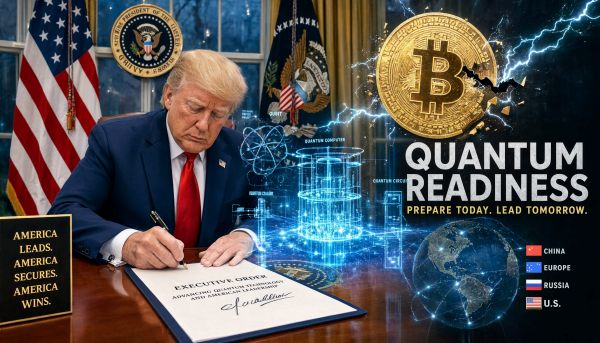
U.S. President Donald Trump has signed 2 executive orders that simultaneously accelerate quantum computing development and the shift to post-quantum cryptography, putting the spotlight back on Bitcoin security risks. The orders do not directly target cryptocurrencies, but concern is growing that the point at which quantum computers can threaten Bitcoin’s cryptographic system could come sooner than expected.
Bitcoin Magazine and other major foreign media reported on June 22 that Trump signed 2 executive orders focused on expanding quantum computing research and development and accelerating the transition to post-quantum cryptography (PQC).
Markets are paying particular attention to the second executive order, which moves up the post-quantum cryptography transition timeline. The U.S. federal government’s target date was shortened by 4 years to December 2031 from 2035. Under the order, the National Institute of Standards and Technology (NIST) must complete pilot conversions for federal systems by the end of 2027, and the Cybersecurity and Infrastructure Security Agency (CISA) will support transition efforts by critical infrastructure operators.
The first executive order focuses on accelerating development of quantum computing technology itself. The White House set a goal of deploying “scientifically useful” quantum computers by 2028 at national laboratories and facilities under the Department of Energy. It also directed the Commerce Department, the Energy Department, the Defense Department and the National Aeronautics and Space Administration (NASA) to draw up plans within the next 5 years to adopt quantum sensors and quantum network technologies.
White House science and technology adviser Michael Kratsios said in a briefing before the signing, “President Trump has long recognized the importance of quantum as an essential task for the economy and national security.”
What the Bitcoin industry is watching is so-called “Q-Day.” It refers to the point at which quantum computers reach performance sufficient to derive private keys using only public keys. In theory, if Q-Day becomes reality, assets in Bitcoin wallets with exposed public addresses could be at risk. Coinbase’s advisory council previously warned in a report that as many as 7 million BTC could be exposed to quantum computer attacks over the long term.
The industry is already discussing countermeasures. Google in March set 2029 as its own deadline. BTQ Technologies launched a Bitcoin testnet based on BIP-360, and developers later proposed BIP-361 to freeze that BTC if holders of vulnerable legacy addresses do not migrate.
Bitcoin’s security model has not changed much since Satoshi Nakamoto’s white paper, and there is still no mandatory upgrade path. Bitcoin also has a long and complex consensus process for protocol changes due to the nature of its network. Revising the existing address system and security model requires broad community agreement, leaving response efforts relatively slow.
Other blockchain projects, by contrast, are moving more aggressively. Stellar recently unveiled a roadmap for a post-quantum transition, and Algorand announced a plan to secure broad quantum resilience by 2027.
The executive orders do not directly regulate the cryptocurrency industry. But some assessments say the U.S. government has sent a clear message by simultaneously moving up timelines for quantum computing and the shift to post-quantum cryptography.
The industry sees a key challenge ahead in how quickly the Bitcoin community can put in place concrete measures, including address migration methods, the adoption of post-quantum cryptography and protocol upgrades.
 Jinju Hong
hongjj@d-today.co.kr
Jinju Hong
hongjj@d-today.co.kr