
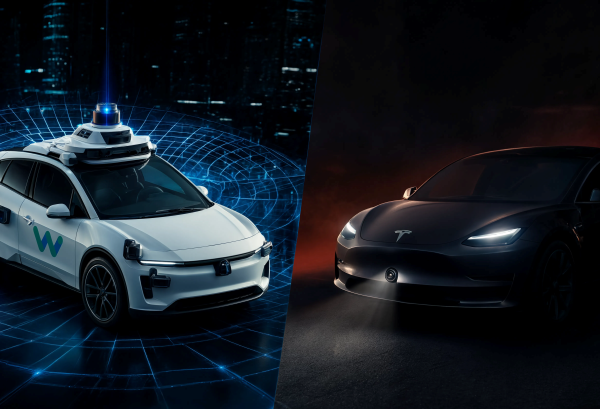
[DigitalToday Seung-a Yoo, intern reporter] Waymo co-CEO Dmitri Dolgov (드미트리 돌고프) said it would be difficult to reach the safety level needed for full self-driving using only cameras.
Electrek reported on Monday that Dolgov said in a Y Combinator Startup School talk that a camera-only approach may suit driver-assistance levels but has limits when it comes to fully driverless operation.
Dolgov acknowledged that humans can drive using only their eyes. "If the goal is to roughly match human-level performance or build a driver-assistance product, it is a very reasonable way," he said. But he drew a line, saying things change if the goal is full self-driving and performance far beyond humans. "Weak sensing makes the safety curve flatten too early, long before it reaches the needed level," he said.
The remarks did not directly name any company but have drawn attention as they align with Tesla's strategy of pushing its camera-based 'Tesla Vision' approach. Tesla removed radar from its vehicles in 2021 and eliminated ultrasonic sensors in 2022. It has since focused on implementing self-driving with cameras alone. Elon Musk has criticised lidar as an inefficient approach.
Waymo also explained why it uses cameras, lidar and radar together. Cameras provide high-resolution and colour information but perform worse in low light or strong glare. Lidar directly measures the three-dimensional structure around the vehicle, while radar can pass through fog, rain and snow and also read speed information. Dolgov stressed that these sensors are not simply a fallback. "These different sensing methods are not each other's backup," he said, adding that combining their data creates "far superior world perception" than using any single sensor.
Waymo offered real-world examples. During a dust storm in Phoenix, cameras could see almost nothing, but lidar identified a pedestrian at the edge of the road. At night, people entering the road over concrete barriers and children running after a dog on dark roads without streetlights or headlights were also hard to identify with cameras, while lidar captured them relatively clearly. Cases where sensor lenses are physically blocked were also cited as a problem. Dolgov described an incident in which a tree branch was not removed by the wipers, and the vehicle used other sensors to return to the depot on its own.
Dolgov also pointed to reliability as the core of the technical debate. He described it as an exponential ladder of "nines". Musk has also called the same concept a "march of nines". Raising performance to 90 percent or 99 percent is relatively easy, but boosting reliability one step at a time after that requires far more effort than before, he said. If a technology that improves quickly early on is interpreted as extending the same way to the end, it can hit a flat section before reaching the performance a real product requires. He also stressed that safety standards differ for demo services, driver-assistance functions and fully driverless cars.
He also pushed back against arguments about cost. Dolgov said Waymo is using sixth-generation hardware and costs have fallen sharply with each generation change. He also warned that excluding sensors such as lidar based on current prices is like betting on short-lived numbers. The industry has reported that the full system price, including the vehicle, Waymo sensor package and a driver, has fallen to about $60,000. The vehicle price alone could be about $20,000 cheaper on Tesla's side, but Dolgov argued it is far more important to have a system that actually operates at scale.
The companies' current operating results also contrast. Tesla started a robotaxi service in Austin in 2025 and confirmed its cumulative driverless mileage over the past year was 380,000 miles, or about 612,000 km. Waymo, by contrast, presented a safety report based on 220 million miles, or about 354 million km, of driverless driving with only passengers onboard. In the report, Waymo said serious-injury crashes were 94 percent lower than for human drivers over the same distance. That means the accident rate is about one-seventeenth of that of human drivers. It is currently handling about 500,000 paid rides per week in 15 U.S. cities and aims to expand that to 1 million per week.
The remarks show that the self-driving race is moving beyond feature demos to large-scale commercialisation and safety verification. The focus going forward is expected to be whether a camera-only approach can expand beyond driver assistance to fully driverless services, and whether multi-sensor systems can prove scalability while reducing cost burdens.
 Seung-a Yoo
ysah@d-today.co.kr
Seung-a Yoo
ysah@d-today.co.kr