
[Digital Today reporter Jinju Hong] SpaceX is seeking to move beyond satellite internet into the mobile telecoms market. It has so far provided a satellite connectivity service that complements coverage black spots. It plans to secure additional spectrum and deploy next-generation satellites to build a service that can compete with the three largest U.S. mobile carriers.
Business Insider reported on Tuesday that SpaceX plans to launch next-generation Starlink Mobile satellites in 2027 and start an upgraded mobile service later that year.
The key is additional spectrum it expects to secure from EchoStar. SpaceX plans to use a total of 65 MHz of spectrum capacity to provide a service far improved from current Starlink Mobile. SpaceX President Gwynne Shotwell (그윈 쇼트웰) said at a recent earnings presentation that the next-generation service would be 100 times better than current Starlink Mobile.
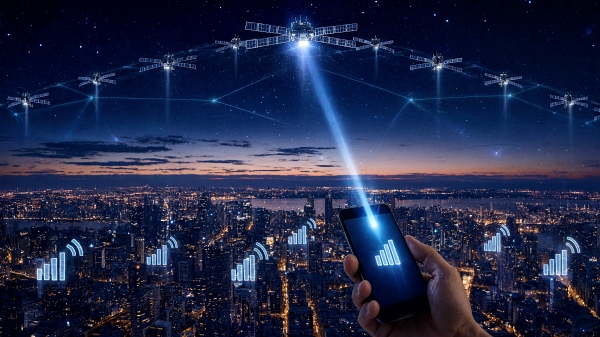
Starlink Mobile currently directly connects satellites to smartphones, offering connectivity in coverage dead zones or during disasters, and is largely a complementary service. SpaceX has said it aims to expand this into the broader mobile telecoms market and compete with major U.S. carriers.
Shotwell named AT&T, Verizon and T-Mobile US as competitors. She said that if service quality improves enough, SpaceX could secure a significant number of customers from existing mobile carriers.
In the United States, Starlink's satellite-to-cell service is being offered in cooperation with T-Mobile under the name 'T-Satellite'. It is not yet at a level that replaces existing 4G and 5G mobile plans. T-Mobile Chief Executive Officer Srinivasan Gopalan (스리니 고팔란) said at an earnings presentation in July that the satellite-to-cell service is closer to complementing the existing network. He said usage of the service accounted for only 0.0003 percent of T-Mobile's total network traffic, even during the summer peak season.
SpaceX plans to build a hybrid structure that combines a terrestrial network with its satellite network rather than competing solely with satellites. Shotwell said the company could deploy low-cost, small base stations that integrate Starlink antennas on a large scale. Unlike the large base station-centric structure used by existing mobile carriers, SpaceX aims to boost network efficiency by using more small base stations. SpaceX CEO Elon Musk (일론 머스크) has also stressed that a network combining satellites and terrestrial networks can provide higher connectivity and bandwidth than existing mobile operators.
Regulatory groundwork for expansion has also been put in place. The U.S. Federal Communications Commission approved the transfer of EchoStar spectrum to SpaceX in May. SpaceX will be able to use the spectrum for a satellite network, a terrestrial network or a combination of both.
Challenges remain before it can compete in the mobile telecoms market. SpaceX did not disclose the specific level of investment needed for the project, and AT&T and Verizon have not issued official positions on related plans.
The industry sees Starlink Mobile's success as hinging on whether it can go beyond an 'emergency satellite connectivity service' and become a real substitute for mobile telecoms.
SpaceX has laid out a plan to overcome the limits of existing telecoms infrastructure by combining satellites and terrestrial networks. How quickly it can secure subscribers while competing with existing carriers that already have nationwide terrestrial networks is expected to face a real test after the service launch in 2027.
 Jinju Hong
hongjj@d-today.co.kr
Jinju Hong
hongjj@d-today.co.kr