
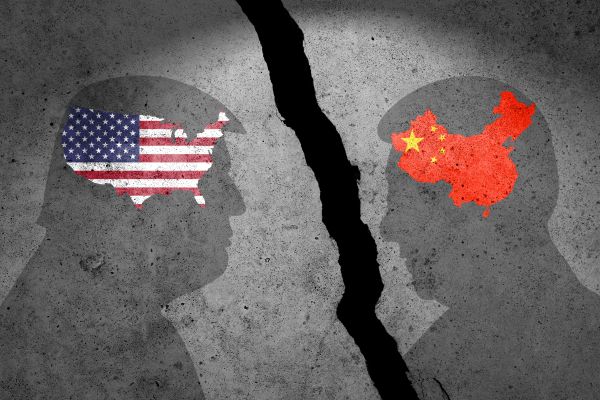
The United States and China are raising the level of technology and trade tensions over AI, robotics, telecoms equipment and drones ahead of a summit planned for September between Chinese President Xi Jinping and U.S. President Donald Trump.
On Aug. 5 local time, the Hong Kong South China Morning Post reported that in recent months the two sides have widened the scope of confrontation from disputes over large AI models to import restrictions, expanded blacklists and tighter export controls.
The latest flashpoint began with a Chinese AI model. Beijing startup Moonshot AI unveiled in mid-July its open-weight large language model "Kimi K3" with 2.8 trillion parameters. Michael Kratsios (마이클 크라치오스), director of the White House Office of Science and Technology Policy, later claimed Moonshot AI used distillation techniques to copy Anthropic's "Claude Fable" model. U.S. Treasury Secretary Scott Bessent (스콧 베센트) also warned that if Chinese companies cross the line into intellectual property infringement through an "industrial-scale distillation attack," they could face sanctions or inclusion on lists subject to export controls.
China pushed back immediately. China's Ministry of Commerce called the U.S. claims a "typical act of AI hegemonism" and said it would take "all necessary measures" to protect its lawful rights and interests. The Communist Party theory journal Qiushi also criticised the U.S. steps as hegemonic actions carried out under the pretext of technology.
The scope of U.S. regulation has expanded beyond AI to industrial equipment. The Federal Communications Commission last week broadened its Covered List targeting foreign-made equipment to newly include advanced robotic equipment and connected power inverters. The new measures block imports and sales of new robotic equipment and power inverters, but do not apply to equipment already purchased. The FCC said advanced robots could create attack paths that allow manipulation of data and physical operations, and inverters could increase vulnerabilities in the U.S. power grid.
China's foreign ministry countered that the United States is excessively broadening the concept of national security to suppress Chinese companies. It also said protectionism would not boost U.S. competitiveness and would only harm the interests of U.S. companies and consumers.
Senior-level consultations continued, but differences did not narrow. Chinese Vice Premier He Lifeng (허리펑) held a video call on July 31 with Treasury Secretary Bessent and U.S. Trade Representative Jamieson Greer (제이미슨 그리어) and conveyed serious concern about recent U.S. economic and trade restrictive measures targeting China. Bessent, in contrast, said the United States demanded that China fully fulfil its commitments related to rare earths and U.S. agricultural products.
Sanctions have spread across supply chains. The U.S. Department of Homeland Security added 43 Chinese companies to its sanctions list under the Uyghur Forced Labor Prevention Act. The affected industries range from food and cotton to pharmaceuticals, metals and lithium production. The law passed the U.S. Congress in 2021 and focuses on blocking from the U.S. market goods made with forced labour linked to the Xinjiang Uyghur Autonomous Region.
China's Ministry of Commerce on Aug. 2 denied allegations of forced labour in Xinjiang and criticised the U.S. steps as economic coercion. It also claimed the measures seriously undermine the legitimate rights and interests of the companies involved and the stability of global industry and supply chains.
The dispute could also shift to key components used in data centres. Reuters reported on Aug. 3 that the FCC is preparing to ban imports of Chinese-made optical transceivers. Optical transceivers are components that transmit data via fibre-optic cables in data centres. U.S. authorities are concerned the devices could be used for data theft, malware distribution or disrupting the operation of data centres that run AI models, and are said to be pushing to announce and implement measures within this year.
China also brought out countermeasures. On Aug. 4, China's Ministry of Commerce shifted shipments of drones and key components and related technologies destined for the United States to an immediate case-by-case review system. China cited national security and non-proliferation obligations. It also added six U.S. companies to its counter-sanctions list, banning transactions and cooperation by Chinese companies and individuals. It added one more company to its blacklist, citing its support, together with the FCC, for introducing measures that harm China's sovereignty.
The two sides have broadened the axes of conflict from a dispute over AI model copyrights to robotics, power equipment, optical communications components, drones, and issues related to raw materials and agricultural product commitments. Senior-level dialogue is being maintained ahead of the summit, but the parallel track of technology regulation and supply-chain sanctions suggests the trend may continue for some time.
 Jinju Hong
hongjj@d-today.co.kr
Jinju Hong
hongjj@d-today.co.kr