
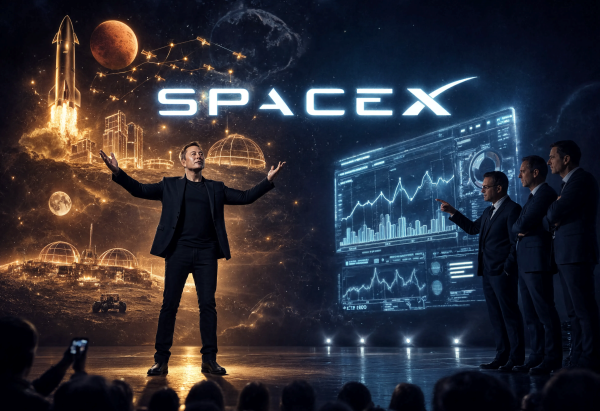
Elon Musk, chief executive of SpaceX, unveiled an aggressive blueprint spanning revenue targets, data centres, Starlink, a moon factory and artificial intelligence at the company’s first earnings conference call since listing. Executives attending alongside him described the same issues far more cautiously and with tighter limits, underscoring a clear difference in tone.
Foreign media outlets including TechCrunch reported on Aug. 4 that the familiar pattern repeated on the call, with Musk proposing bold goals and executives tempering them to a more realistic level. A similar dynamic has appeared at Tesla, and recent analysis has also found that while Musk focuses on future visions, other executives tend to spend more time explaining core businesses such as car sales.
The revenue outlook drew particular attention. Musk said SpaceX’s internal forecast has moved forward the point at which it reaches $1 trillion in revenue from 2031, which had been presented before the listing, to 2030. He did not rule out reaching it in 2029. Walmart and Amazon, cited as comparisons, posted net sales of $706 billion and $717 billion, respectively, in their most recent fiscal years. SpaceX’s revenue in the first half of this year was $12.5 billion, up 54 percent from a year earlier. Musk has also presented aggressive schedules for full self-driving and crewed Mars exploration that were later delayed. In 2018, he said he is "typically optimistic" on timelines, while adding that "what I predict almost always happens, but not on the exact timescale."
He also made bold remarks about data centres. Musk said "building a data centre is not rocket science" and that rocket development is far harder. He joked that putting rocket engineers in charge of building data centres would be like the New York Yankees playing a Little League team, calling it a "trivial problem" for them. Microsoft, Meta, Amazon, Alphabet and Oracle are investing hundreds of billions of dollars to build data centres to secure AI competitiveness, and demand for semiconductors, power and water is surging as a result.
He offered an even more optimistic outlook for Starlink. Musk said SpaceX is preparing to launch Starlink V3 satellites with sharply improved bandwidth, and that based on the countries where SpaceX operates, Starlink could provide more than half of the world’s internet within 10 years. Chief Operating Officer Gwynne Shotwell (그윈 쇼트웰) said adding V3 satellites would allow the company to take on more customers while maintaining service quality, and she expects Starlink to account for a significant portion of global internet traffic within the next few years. Even on the same topic, the intensity of their phrasing differed clearly.
A similar scene played out in financial guidance. Chief Financial Officer Bret Johnsen (브렛 존슨) said the company has signed additional contracts worth $6.7 billion in cloud-service revenue, measured over the six months starting in October this year, through its compute-leasing business that provides computing power to AI companies. He said that including Cursor, the company is on track to reach an annual recurring revenue run rate of $100 billion by year-end, while making clear that the figure is calculated by annualising expected revenue in December. Musk later said that "$100 billion ARR is achievable even if we do virtually nothing" and expressed confidence that actual performance is likely to be higher.
He also extended his space-development vision. Musk said SpaceX "will build a factory on the moon" and that robots would handle the construction work. He said the idea may sound like science fiction now, but over the long term it could expand the scale of intelligence usable in space to 1,000 times, and even 1,000,000 times, the Earth’s economy. On AI, he praised 'Claude 4.5,' released last September, and forecast that by the end of next year it would be hard to find things AI cannot do, at least in the digital domain.
The difference in tone continued on the Starship development timeline. Musk said the prototype rocket could complete preparations for crewed flight by the end of next year, and that around this time next year it could reach a pace of at least one flight per day. Shotwell said the company is currently focused on meeting milestones under NASA’s Artemis programme and that "the goal is to land people on the lunar surface in 2028."
Those plans are possible only if Starship’s fully reusable technology is successfully implemented. A key is the heat-shield system that protects the vehicle during atmospheric re-entry. SpaceX said it achieved the best results yet for an improved heat-shield system in last month’s test flight, but Musk declared that "the heat-shield issue has been solved" even before recovery operations were finished.
Musk has previously presented aggressive schedules for Mars exploration and autonomous driving, but many did not materialise as planned. This time is different in that SpaceX is a listed company. Comments by executives at listed companies can fall under investor protection and disclosure responsibilities. Recent analysis also says that given the U.S. Securities and Exchange Commission and the Justice Department are showing a tendency to ease corporate penalties, and that SpaceX is incorporated in Texas, investors would have limited practical responses even if the outlook misses the mark.
 Seungah Yoo
ysah@d-today.co.kr
Seungah Yoo
ysah@d-today.co.kr