
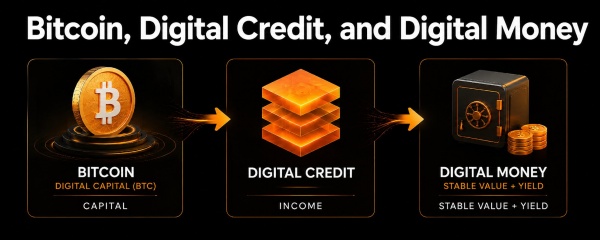
Michael Saylor, chairman of Strategy, has proposed a five-tier financial structure that uses bitcoin as a base asset and builds layers above it ranging from credit and currency to yield products and stocks.
On June 16, CoinPost reported that Saylor unveiled on X, formerly Twitter, a “digital asset stack” concept that places bitcoin at the foundational layer of “digital capital.”
At the core of Saylor’s structure is a method of stacking capital-market products on top without changing the bitcoin protocol. The first layer is digital capital, meaning bitcoin itself. The second layer is digital credit, yield products backed by bitcoin collateral such as STRC-type preferred securities. The third layer is digital currency, aimed at stable value and returns in fiat terms. The fourth layer is digital yield, high-return products using leverage or structuring. The fifth layer is digital assets, described as MSTR-type common stock.
He then said he views bitcoin’s price volatility not as a weakness but as material for financial product design. Rather than changing bitcoin’s nature, the plan is to create product layers tailored to different investor demand and absorb it.
The most notable parts of the structure are the second and third layers. Saylor explained that digital credit is a layer that absorbs bitcoin volatility while providing more stable returns. Citing STRC as an example, he argued that combining senior claims, income and a common-stock buffer structure could ease bitcoin price swings.
He presented digital currency as a structure that seeks stable value and returns by combining digital credit with fiat-based liquid assets such as short-term government bonds. Saylor mentioned 6 to 8 percent a year as an example of expected returns. He added that stable value does not mean risk-free and said it should be assessed through reserve-asset composition, liquidity, credit structure and transparency.
He also laid out choices by investor type. Investors who want to hold bitcoin directly can stay in the first layer, while those seeking income can choose digital credit, and depositors and payment users seeking stable value can opt for digital currency. Investors aiming for high returns move to digital yield, and growth investors seeking upside shift to digital assets. “The answer is not to change bitcoin, but to build products that fit each investor’s demand within the bitcoin ecosystem,” he said.
From a market perspective, Saylor highlighted the potential for new capital inflows, particularly through digital money. He argued that digital currency could broaden bitcoin adoption and ultimately raise liquidity and price stability. On why a fiat-linked structure is needed, he said wages, bills, taxes and mortgages still operate on a fiat basis. He presented a division of roles in which digital money handles dollar-based payments and store-of-value demand, while bitcoin takes on the role of capital preservation.
He also raised concerns about existing stablecoins. Saylor said that while stablecoins provide liquidity, they do not return enough of the yield generated from reserve assets to holders. He added that the newly proposed digital currency could position itself as a product that addresses that limitation.
The proposal is notable in that it stacks financial products reflecting differing risk appetites and income demand on top of bitcoin rather than changing bitcoin itself. Saylor described a plan to expand bitcoin from a foundational layer of digital capital into capital-market infrastructure linking credit and currency to yield products and an equity structure. He added that collateral stability, liquidity, profit distribution and regulatory compliance are likely to be key variables in the process of turning it into actual products.
https://t.co/vpJ4mVDwhn
 Yoonseo Lee
yslee@d-today.co.kr
Yoonseo Lee
yslee@d-today.co.kr