
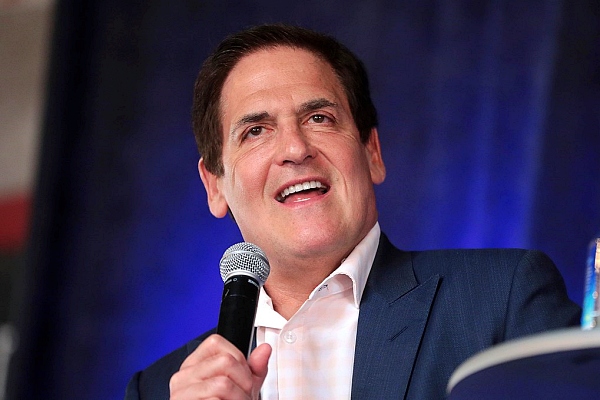
[DigitalToday reporter Yoonseo Lee] U.S. billionaire investor Mark Cuban (마크 큐반) said he sold most of his bitcoin holdings.
On May 22 (local time), blockchain media outlet CoinPost reported that Cuban said on a podcast he sharply reduced his bitcoin exposure because it did not play the role he expected in the recent market environment.
Cuban once filled 60 percent of his cryptocurrency portfolio with bitcoin. But he said he concluded bitcoin did not move as an inflation hedge despite a weaker U.S. dollar and heightened tensions in the Middle East. He explained that he was disappointed that while gold surged to $5,000 an ounce, bitcoin instead fell.
The remarks contrast with Cuban's past stance. In a 2021 interview, he argued that bitcoin, which has a capped supply, could be a better store of value than gold. At the time, he said he had never sold bitcoin and stressed a long-term holding stance.
Cuban's decision to sell also touches on a market debate over whether bitcoin functions as "digital gold". The market continues to debate whether bitcoin will act as a defensive asset during macroeconomic instability or move up and down alongside other risk assets. Cuban said bitcoin did not show the hedge characteristics he expected in the latest trend.
By contrast, he said he was not as disappointed with Ethereum and other cryptocurrency projects as he was with bitcoin. He assessed that Ethereum maintains distinct value in terms of practical use, including smart contracts and decentralised finance (DeFi). It was read as an understanding that projects with a clear basis for use can be judged by different standards regardless of whether they defend their price.
That view of Ethereum is also linked to the current market perspective. As scepticism grows about bitcoin's inflation hedge function, infrastructure blockchains that can host various applications are being valued as separate growth assets. Cuban, too, appears to have dropped his expectations for bitcoin while still recognising the practicality of smart contract-based networks.
As the cryptocurrency market matures, investors' evaluation standards are also becoming stricter. In the past, assets could draw attention based only on technological symbolism or scarcity, but now there is also scrutiny of what performance they have delivered in actual markets and what differentiation they offer compared with other assets.
In particular, the remarks are drawing attention as a change in position by a well-known investor. The fact that he has stepped back from his previous stance of holding bitcoin for the long term sends a significant signal to the market. Still, Cuban made clear that rather than rejecting bitcoin outright, he is disappointed in its performance as a hedge in the recent macro environment. As a result, the market is expected to continue debating whether bitcoin's role should be seen as a store of value or as an asset with stronger risk-asset characteristics.
 Yoonseo Lee
yslee@d-today.co.kr
Yoonseo Lee
yslee@d-today.co.kr