
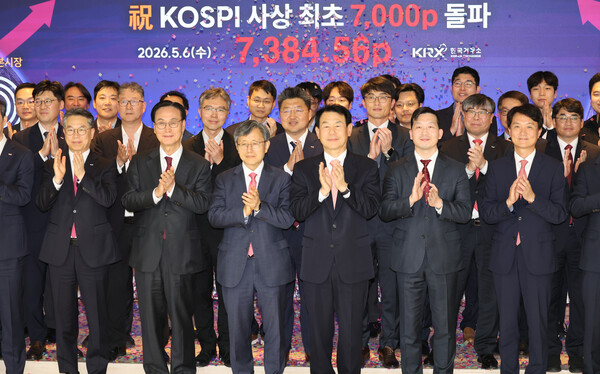
South Korea's KOSPI touched the 7,000 mark for the first time. Expanded investment in semiconductors and artificial intelligence infrastructure, foreign inflows, retail inflows via exchange-traded funds (ETFs) and capital market advancement policies combined to open the 7,000 era.
The KOSPI rose as high as 7,426.60 intraday on May 6 before closing at 7,384.56. It crossed 7,000 about 2 months after first breaking above 6,000 on Feb. 25.
The market capitalisation of the main board hit a record 6.06 quadrillion won. Market value had been 5.02 quadrillion won when the index first crossed 6,000, meaning it grew by more than 1 quadrillion won in a little over 2 months.
The KOSPI's gain this year also far outpaced major global stock markets. The Korea Exchange said the KOSPI was up 75.2 percent this year, the highest among G20 countries. It was far above the gains in benchmark indexes in countries including Turkey, Japan and Brazil over the same period.
Semiconductors and AI infrastructure open the KOSPI 7,000 era.
The biggest driver behind the KOSPI's move above 7,000 was semiconductors. Major chip stocks such as Samsung Electronics and SK Hynix led the index higher as expanded global AI investment combined with rising demand for high-performance memory.
The Korea Exchange said semiconductor exports in April jumped 173 percent from a year earlier to $31.9 billion. That followed $32.8 billion in March, keeping exports at a high level.
Expanded AI infrastructure investment also shifted market direction. Buying spread to power equipment, construction infrastructure, and materials, parts and equipment sectors needed for expanding data centres.
By sector this year, electrical and electronics rose 124.8 percent, construction climbed 129.2 percent, machinery and equipment gained 78.5 percent, and transport equipment and parts rose 39.6 percent. The rally broadened from semiconductors alone to include power equipment, construction, shipbuilding, nuclear power and defence.
Retail investors held the line and foreigners pushed it higher.
On the flow side, retail investors and foreigners lifted the index with a time lag. Retail investors steadily bought local shares from the start of the year, absorbing foreign selling in February and March. From April, foreigners shifted to net buying, mainly in electrical and electronics, accelerating the rise.
The Korea Exchange said foreigners were net sellers of 21.1 trillion won in February and 35.9 trillion won in March in the KOSPI market, but turned to net buying of 1.1 trillion won in April and 6.1 trillion won in May.
Foreign buying in May was concentrated in semiconductors. The securities industry sees foreigners net buying more than 7 trillion won of local shares in May alone, with purchases overwhelmingly skewed to large caps and electrical and electronics, effectively semiconductors.
Foreigners were net buyers of Samsung Electronics worth 3 trillion won on the day, after buying SK Hynix worth 2.1 trillion won earlier. The surge in major chip stocks lifted the index, while the Kosdaq and smaller KOSPI stocks were relatively left behind.
Gains in leading chip stocks also spread to conglomerate affiliates. Samsung Electronics surged on expectations Apple would diversify foundry suppliers, and shares of group firms holding Samsung Electronics stakes, including Samsung C&T and Samsung Life Insurance, also rose.
SK Hynix also extended its record-high run, lifting related group stocks such as SK Square and SK. The move reflected both expectations for semiconductor performance and a revaluation of stake value at the same time.
A virtuous funding cycle built by ETFs and policy.
Growth in the ETF market was also a key pillar behind the KOSPI reaching 7,000. Rising KOSPI levels lifted ETF values, and money flowing into ETFs fed back into purchases of underlying assets. As of the morning, there were 1,099 domestically listed ETF products with market capitalisation of 449 trillion won.
ETF net assets also grew to around 439 trillion won, nearing 450 trillion won. After exceeding 100 trillion won in June 2023, it broke 300 trillion won in January, then 400 trillion won in April, accelerating its growth pace.
Improvements to capital market rules are also cited as a factor behind a re-rating. Revisions to the commercial law, separate taxation on dividend income and expanded tax support for value-up best performers raised expectations for shareholder returns. Broader use of integrated foreign investor accounts and stronger requirements for disclosures in English also improve access for foreigners.
Foreign trading accounts for the low 20 percent range of domestic turnover, below Japan and Taiwan, and an analysis says improving access through global online brokerage platforms could broaden the foreign investor base.
The index jumped, but concentration grew.
The KOSPI 7,000 era is not purely optimistic. Concentration in large caps is clear. The KOSPI has surged recently, but only some stocks across the main board have risen.
As funds pile into sectors including semiconductors, securities and power equipment, the gap between the index gain and investors' perceived returns is widening. If the large-cap-led market continues, the sense of being left behind among small-cap and Kosdaq investors could grow.
There is also the burden of overheating after the short-term surge. During the rally on the day, a temporary trading halt on program buy orders, a buy-sidecar, was triggered. It was the eighth trigger this year, signalling strong upward momentum but also a sign that short-term volatility has increased.
Leverage buying and external variables remain challenges.
The nature of retail funding also needs review. With customer deposits nearing 130 trillion won, margin lending balances also rose to record highs. Leverage can boost returns in a rising market, but in a correction it can trigger forced selling and larger losses.
With expectations rising for the launch of single-stock leveraged ETFs, concentration in specific stocks and themes could increase market volatility.
External variables also remain. U.S.-Iran tensions have shown a trend toward easing, but geopolitical uncertainty has not been resolved.
If international oil prices rise again, inflation pressure could grow and increase the burden on monetary policy in major economies.
The U.S. 10-year yield, the dollar-won exchange rate and oil price trends are factors that influence the discount rate for South Korean equities. If high oil prices and high interest rates persist, the logic of improved earnings expectations and valuation re-ratings could weaken.
After 7,000, the key is earnings durability.
Ultimately, the sustainability of the KOSPI at 7,000 depends on earnings. The market is currently pricing in profit growth centred on semiconductors and AI infrastructure. It is a symbol that the undervaluation of South Korean stocks is starting to be resolved, but also a period that requires testing of market strength.
If semiconductor and AI infrastructure results continue as expected and capital market advancement policies lead to wider shareholder returns, there is room for further gains. If inflows and policy expectations run ahead without earnings confirmation, pressure for a correction could also grow.
Lee Jae-won (이재원), a researcher at Yuanta Securities, said, "Samsung Electronics and SK Hynix's relative strength index has entered the overbought zone, so there is a possibility of a short-term adjustment," but added, "Earnings estimate upgrades are continuing, so the trend is expected to hold."
He added, "The KOSPI's 12-month forward earnings per share are 966 points and the 12-month forward price-to-earnings ratio is 7.18 times, so valuations, now that it has broken above 7,300, are still in deep value territory," and said benefits from direct purchases of local shares by foreign retail investors and record net foreign buying in May are also factors supporting the market's downside.
 Oh Sang-yup
yub@d-today.co.kr
Oh Sang-yup
yub@d-today.co.kr