
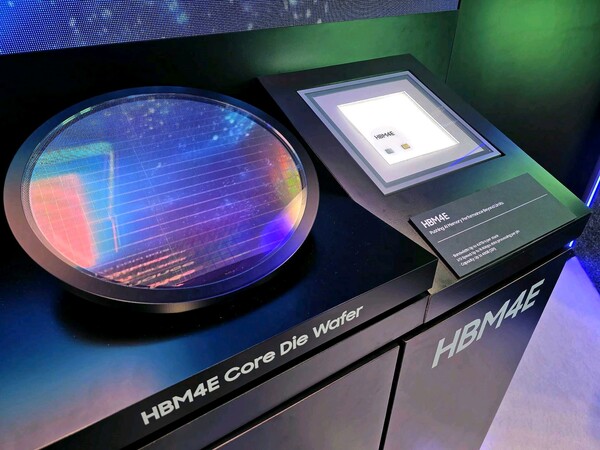
Samsung Electronics and SK hynix have diverged on timelines for shipping samples of HBM4E, a seventh-generation high-bandwidth memory. Samsung has formalised plans to release its first sample in the second quarter, while SK hynix has set a target of supplying samples in the second half and mass-producing in 2027. Both are based on the 1c, 10-nanometre-class sixth-generation process, but they have set differentiation points in different directions, drawing attention to the direction and outcome.
Samsung disclosed the HBM4E schedule and specifications on April 30 during its first-quarter conference call. The company said it is accelerating preparations for next-generation HBM4E products that support 16 gigabits per second per pin and 4.0 terabytes per second of bandwidth, and plans to ship the first sample in the second quarter. A notable point is that it presented specific performance figures. Samsung said it is continuing business preparations for next-generation products based on its 1-nanometre-based technology competitiveness accumulated through mass production of HBM4.
SK hynix disclosed its schedule in a somewhat different tone. The company said it is working closely with key customers from the early stage and is preparing to target mass production in 2027 after supplying samples in the second half. In terms of sample shipments alone, the schedule is 1 to 2 quarters later than Samsung. SK hynix clearly presented 2027 as the mass production timing, while Samsung did not separately disclose a mass production date. Given that there is typically a need for customer qualification procedures and a period of yield stabilisation between sample shipments and mass production, the two companies' mass production timing may converge to a similar point in 2027. That is because a gap in sample shipment timing does not directly translate into a gap in mass production timing.
Because the process base is the same, the memory industry is set up for competition in next-generation HBM on the same generation of process technology. But the differentiation cards have been set in different directions. Both Samsung Electronics and SK hynix have put forward the 1c (10-nanometre-class sixth-generation) process as a core technology for HBM4E.
Samsung highlighted the performance specifications themselves. The company said that at the HBM4 stage it already "drove an upward adjustment in HBM4 performance specifications by using the most advanced process based on 1-nanometre technology". The company's analysis is that a structure formed in which customers adopted this and the performance edge translated into a price premium. By first disclosing specific performance figures of 16 Gbps and 4.0 TB/s for HBM4E, it is continuing the same strategy.
SK hynix presented manufacturing stability and base die optimisation as differentiation points. Responding to a question from Citigroup, the company said, "Base die optimisation and applying the 1c nanometre process, which has proven the industry's top-tier performance, are key," adding, "Based on 1c mass production capability that has already reached a mature stage, we will supply stable performance and volume on time in HBM4 and HBM4E as well to maintain technology leadership." It is a structure that puts forward stability in the mass production stage and the ability to supply on time, rather than performance figures, as weapons. The base die is a component located at the very bottom of an HBM stack that plays the role of a memory controller, and the level of optimisation determines the overall HBM's power efficiency and signal processing performance.
◆Different weapons on the same 1c process... Securing the HBM4 market will shape the HBM4E starting line
The outcome of securing the first-generation HBM4 market is likely to affect the starting line for HBM4E competition. Samsung began mass-production shipments of HBM4 in February, the first in the industry, and HBM4 revenue is expected to exceed half of total HBM revenue from the third quarter this year. It is also expected to account for a majority of HBM revenue for the full year of 2026. The company said, "All prepared capacity is sold out."
SK hynix also secured demand visibility at the HBM4 stage. The company said, "Over the next three years, the demand requested by customers is already at a level that far exceeds our supply capabilities." It means demand for the next three years, including HBM4E, already exceeds capacity. Both companies share the view that the demand-supply gap is becoming structural at the HBM4 stage.
The speed of securing capacity has emerged as the next variable. SK hynix decided to bring forward the start-up of its Yongin Phase 1 fab by three months, from May 2027 to February. The company said, "At this point, there are no additional construction plans beyond Yongin, but we will meticulously prepare all production infrastructure so that we can respond flexibly to the structural increase in demand in the AI era."
Samsung also hinted at the need for future capacity expansion, saying "demand for 2027 is being booked in advance". Because HBM is structured such that even if DRAM capacity is increased, additional time is needed to secure backend packaging lines, the timing of the decision to expand capacity is cited as a variable that will determine market share after 2027.
HBM4E schedules at global memory rivals including Micron are also variables. But the two companies did not directly mention rival schedules in their conference calls. The year 2027, when HBM4E enters full-scale mass production, is expected to be a turning point that separates the memory duopoly's market share in next-generation HBM.
Whether Samsung can take an advantageous position in securing early customers as it brings forward its sample shipment timing, and whether SK hynix can narrow the gap in the full mass production stage using manufacturing stability as a weapon, are points to watch for the competitive landscape. An industry official said, "Depending on what results the two companies produce in HBM4E, the landscape of memory technology leadership could be reshaped once again."
 Daegeon Seok
d2dg@d-today.co.kr
Daegeon Seok
d2dg@d-today.co.kr