
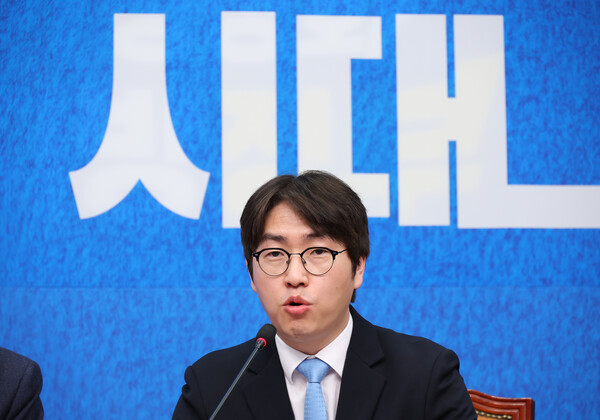
With the post of AI future planning secretary at the presidential office now vacant, attention is focused on the future direction of the national artificial intelligence strategy. As former AI secretary Ha Jung-woo (하정우) moves into politics, some have raised concerns that continuity in key policies supporting the goal of becoming one of the world’s top three AI powers could be shaken.
Ha recently formalised his entry into politics after leaving the presidential office. He will run as the Democratic Party candidate in a parliamentary by-election in Busan’s Buk-gu Gap district, which will be held alongside the June 3 local elections. President Lee Jae-myung approved Ha’s resignation on April 28. A day later, on April 29, the Democratic Party recruited Ha as talent and made his by-election run official.
◆Industry raises concerns over future AI policy direction as 'HaGPT' runs for office
Since last month, Ha’s next move has drawn attention in the industry. As speculation grew that he would run in a parliamentary election, the possibility of revisions to the national AI strategy was discussed. With many IT companies participating in national AI projects, voices emerged saying it was difficult to predict the future direction.
The industry has also shown regret that he is leaving the presidential office in less than a year after being appointed as the first AI secretary. The view is that it is too early a move into politics, with major government AI projects such as an in-house AI foundation model project and the National AI Computing Center still unfinished. A cloud industry official said, "From the industry’s standpoint, it is an extremely bewildering decision," and added, "It is disappointing to see such a sudden turn toward politics when the national AI ecosystem is only just beginning to take shape."
Still, some see Ha’s move as an extension of efforts to push AI policy. The interpretation is that, because related legislation must underpin the government’s goal of becoming one of the world’s top three AI powers, it is a choice aimed at boosting policy execution in the National Assembly. Some also say Ha may have judged that there are limits to building an AI ecosystem through a role as a presidential office aide alone.
◆Finding a successor will not be easy; attention on the ministry’s role
Expectations and concerns about a successor have surfaced. Ha joined the presidential office after serving as head of Naver Cloud’s AI Innovation Center, among other roles. With a PhD in computer engineering from Seoul National University, he researched AI while working in the private sector. At Naver, he was seen as building an expert network and an ability to communicate externally while also leading AI organisations. The industry’s overall view is that it will not be easy to find a successor who combines AI expertise and political acumen to the same degree as Ha.
An industry official said, "With AI, it is especially important to read fast-changing technology trends," and added, "Experience responding quickly to changes and driving projects in the private sector likely became a major asset for Ha." This aligns with the background to the presidential office’s decision to appoint him. On June 15 last year, presidential chief of staff Kang Hoon-sik said, announcing Ha’s appointment, that President Lee had remarked that authority and responsibility should be entrusted to a private-sector expert who knows the field best to quickly improve national competitiveness in AI.
Ha’s decision to run has also increased the burden on the Ministry of Science and ICT. While the AI secretary designs the overall national AI strategy, the ministry is the lead agency that moves to implement it.
The ministry has already been coordinating science and technology policy across ministries in this administration after being elevated to a deputy prime minister-level ministry, including by chairing meetings of science and technology-related ministers. Deputy Prime Minister and Science Minister Bae Kyung-hoon, formerly head of the LG AI Research Institute, is an AI expert comparable to Ha. This year alone, Bae accompanied President Lee on visits to China, Singapore and the Philippines, and Vietnam, acting as a strategist promoting South Korea’s AI policy.
An industry official said, "Until a successor secretary is decided, Deputy Prime Minister Bae’s role is extremely important," and added, "But because he cannot replace 100 percent of the AI secretary’s role within the government structure, work is needed to quickly find a successor."
 Jin-ho Lee
jhlee26@d-today.co.kr
Jin-ho Lee
jhlee26@d-today.co.kr