
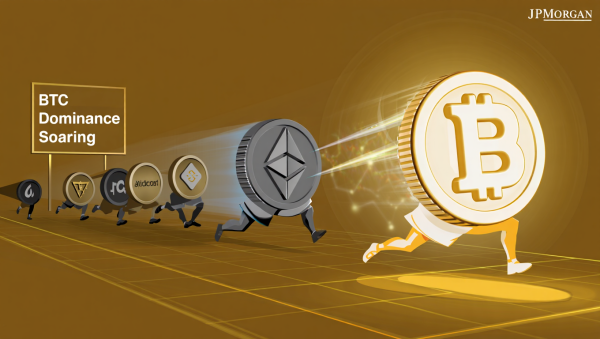
[DigitalToday reporter Jinju Hong] JPMorgan warned that weakness in Ethereum (ETH) and major altcoins could persist for the time being. Bitcoin (BTC) is maintaining relative strength on institutional money and spot ETF demand. Ethereum and altcoins, by contrast, are recovering more slowly amid fading network activity and weaker liquidity, the bank said.
On May 15, local time, blockchain media outlet CoinPost reported that JPMorgan's analysts said the cryptocurrency market has entered a rebound phase after a steep drop driven by geopolitical tensions. Even so, Ethereum and major altcoins are still extending a weaker trend versus bitcoin, they said.
The team, led by Nikolaos Panigirtzoglou, said the trend has already persisted since 2023. The report said it would be difficult for Ethereum and altcoins to reverse their relative disadvantage unless there is a "meaningful improvement" in DeFi, real-world use cases and network activity.
Market fund flows also showed a tilt toward bitcoin. Bitcoin spot ETFs have recovered about two-thirds of their recent outflows, while Ethereum spot ETFs have regained only about one-third. Chicago Mercantile Exchange (CME) futures positions in bitcoin are close to pre-crash levels, but Ethereum has yet to recover.
JPMorgan also said momentum-focused investors such as commodity trading advisers (CTAs) and crypto quant funds are still keeping conservative positions. It said both bitcoin and Ethereum remain underweight after deleveraging in October last year.
JPMorgan pointed to low liquidity, shallow market depth, slowing DeFi activity and repeated hacks and security incidents as reasons for broader weakness in the altcoin market. It said those factors "weakened confidence in the overall altcoin ecosystem and limited new inflows."
On-chain data also showed a shift. Based on DefiLlama, Ethereum's share of total value locked (TVL) in DeFi fell to about 53 percent in May this year from 63.5 percent in early 2025. The absolute amount is still the largest at about $45.5 billion, but some funds are moving to rival chains such as Solana (SOL) and BNB Chain, the report said.
JPMorgan kept a cautious view on Ethereum upgrades scheduled for this year. The report cited the next-generation upgrades, "Glamsterdam" and "Hegota," as key variables, but said upgrades in recent years have mainly focused on cutting Layer 2 transaction costs.
As a result, network fee revenue has fallen and pressure for net supply increases has grown as the ETH burn mechanism weakened, it said. That could weigh on ETH prices over the long term, the report said.
The Ethereum Foundation (EF) recently disclosed the development status of Glamsterdam at an interoperability event held in Svalbard, Norway. Core functions ePBS and BAL are operating stably on a testnet, and it is reviewing plans to expand the post-upgrade gas limit target to 200 million from the current 60 million.
A target for main deployment was presented as the first half of 2026, but some developers also cited the possibility that actual implementation could be delayed until after the third quarter.
JPMorgan said the core issue is growth in real demand rather than the technical improvements themselves. The report said the most important variable is whether upgrades can expand network activity and generate enough usage demand to offset reduced burning and rising pressure for net supply increases.
As a result, the market is increasingly focusing on whether Ethereum's future price moves will depend not on upgrade announcements themselves but on actual network usage and a recovery in DeFi activity.
 Jinju Hong
hongjj@d-today.co.kr
Jinju Hong
hongjj@d-today.co.kr