
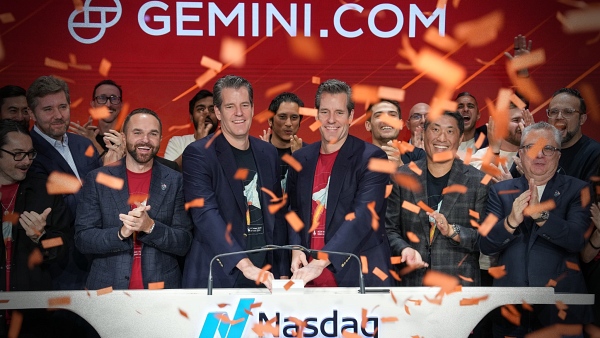
Crypto exchange Gemini surged in after-hours trading after raising an investment worth $100 million from its founders, the Winklevoss twins. Investor focus is also on whether results that beat market expectations could mark a rebound after a prolonged slump.
CNBC reported on May 14 local time that Gemini disclosed the investment from the Winklevoss Capital fund alongside its first-quarter earnings. After the announcement, the shares jumped as much as about 30 percent in after-hours trading and later held gains of around 17 percent.
The investment was carried out by a venture fund run by brothers Tyler Winklevoss and Cameron Winklevoss, which bought Gemini Class A common shares at $14 a share. The payment was made in bitcoin (BTC).
The direct infusion of founder money is interpreted as a trigger to restore investor sentiment that had worsened. Chief Executive Tyler Winklevoss (타일러 윙클보스) said in a statement that the market is greatly undervaluing Gemini and that the investment will serve as a foundation for preparing the company for its next stage of growth.
He said Gemini has achieved several milestones in product development and regulatory responses, and stressed that it is positioned to evolve beyond a simple crypto company into a market-centered platform. He added that the investment will provide momentum for its long-term growth strategy.
Results also beat expectations. Gemini posted a first-quarter loss per share of 93 cents. That compared with a FactSet estimate of a $1.03 loss per share. Revenue was $50.3 million, above an expected $47.9 million.
Performance by business segment was mixed. Core exchange revenue fell 27 percent from a year earlier to $17.2 million. Credit card revenue rose about 300 percent from a year earlier to $14.7 million. Service revenue and interest income also increased 122 percent from a year earlier to $24.5 million.
The market is assessing this as a sign that a strategy to diversify revenue sources away from a fee-driven structure is beginning to produce some results.
Gemini has had a difficult time since its listing in September last year. Investor sentiment weakened as continued losses, management departures, a pullback from some overseas markets, and a shift toward artificial intelligence (AI) and prediction-market focused businesses unfolded at the same time. A class action lawsuit is also under way in New York alleging investors were misled during the initial public offering (IPO) process.
The share decline has also been steep. Gemini surged 14 percent on its first trading day and hit an intraday 52-week high of $45.89, but closed at $5.26 in regular trading on May 14. Over the same period, bitcoin prices are also down about 30 percent.
Market focus is now on how much Gemini can reduce its dependence on the crypto sector. Recently listed crypto companies face pressure to build stable revenue structures not dictated by trading volumes and market sentiment.
Co-founder and president Cameron Winklevoss (카메론 윙클보스) recently said, "The company’s roots are in crypto, but that is not the whole story," and added, "If we build a business structure more closely connected to the market, we can ease revenue volatility."
As a result, the key point to watch is not so much the founder investment itself as whether non-exchange businesses such as credit cards and services can actually become Gemini’s main revenue pillars.
 Jinju Hong
hongjj@d-today.co.kr
Jinju Hong
hongjj@d-today.co.kr