
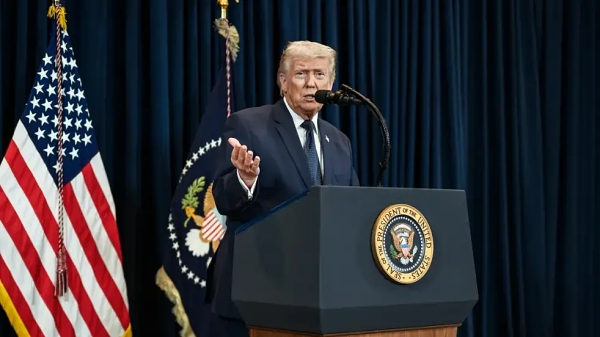
About 40 percent of the delegation of chief executives from major U.S. companies accompanying President Donald Trump on his China visit is directly or indirectly linked to cryptocurrency businesses.
On May 11, blockchain media outlet BeInCrypto reported that Trump is expected to visit Beijing this week with about 17 U.S. company CEOs and meet Chinese President Xi Jinping.
Chinese state media reported that the state visit is scheduled for May 13 to 15. The delegation is made up of industries central to U.S.-China trade talks, including technology, finance, aerospace and agriculture. The list includes Elon Musk (일론 머스크), Tesla's CEO; Tim Cook (팀 쿡), Apple's CEO; and Larry Fink (래리 핑크), BlackRock's CEO, as well as Kelly Ortberg (켈리 오트버그), Boeing's CEO; Stephen Schwarzman (스티븐 슈워츠먼), Blackstone's chairman; Jane Fraser (제인 프레이저), Citigroup's CEO; David Solomon (데이비드 솔로몬), Goldman Sachs' CEO; and Dina Powell McCormick (디나 파월 매코믹) of Meta Platforms. H. Lawrence Culp (H. 로런스 컬프), GE Aerospace's CEO; Cristiano Amon (크리스티아노 아몬), Qualcomm's CEO; Sanjay Mehrotra (산제이 메흐로트라), Micron's CEO; Chuck Robbins (척 로빈스), Cisco's CEO; Brian Sikes (브라이언 사익스), Cargill's CEO; Ryan McInerney (라이언 맥이너니), Visa's CEO; Michael Miebach (마이클 미에바흐), Mastercard's CEO; Jim Anderson (짐 앤더슨), Coherent's CEO; and Jacob Thaysen (제이컵 테이슨), Illumina's CEO, are also slated to attend. Jensen Huang (젠슨 황), Nvidia's CEO, is not on the delegation list.
Market attention is focused on the share of companies tied to digital assets. BlackRock runs the largest product among spot bitcoin exchange-traded funds. Tesla holds 11,509 BTC. Visa and Mastercard are pushing to expand stablecoin payment infrastructure, and Goldman Sachs is also connected to the cryptocurrency trading sector.
The direct agenda for the China visit is trade and supply chains. Trump plans to put aircraft purchases, soybean imports and rules on semiconductor exports on the negotiating table. Boeing and GE Aerospace will raise aircraft order issues that have repeatedly been discussed in summit talks. Cargill will serve as an agricultural negotiating card, based on China's demand for soybean purchases. Apple, Micron and Qualcomm represent semiconductor export and supply-chain issues exposed to tariffs and regulation.
Wall Street's interests are also clear. Paul Barron cited Jane Fraser, David Solomon, Stephen Schwarzman and Larry Fink, and pointed to their financial companies going to Beijing to protect existing business licences and demand "mutual market access." He also said that, in conjunction with the possibility that Trump could ease secondary sanctions on Chinese banks linked to Iran, those firms are signalling that Wall Street remains open to inflows of Chinese capital.
The cryptocurrency market is closely watching the possibility of such changes in financial flows. There was a view that market sentiment could strengthen if BlackRock's bitcoin ETF business and Goldman Sachs' cryptocurrency trading division benefit from any easing in financial flows between the United States and China. The outlet reported that the market could price in the possibility that Wall Street's acceptance of cryptocurrency becomes more full-scale.
The outcome of the talks is expected to be a signal for gauging the direction of U.S.-China relations over tariffs, artificial intelligence export controls and rare earths. With the market having repeatedly reacted to tariff-related remarks, the Beijing negotiating result could affect price sentiment in cryptocurrency as well as traditional finance.
 Jinju Hong
hongjj@d-today.co.kr
Jinju Hong
hongjj@d-today.co.kr