
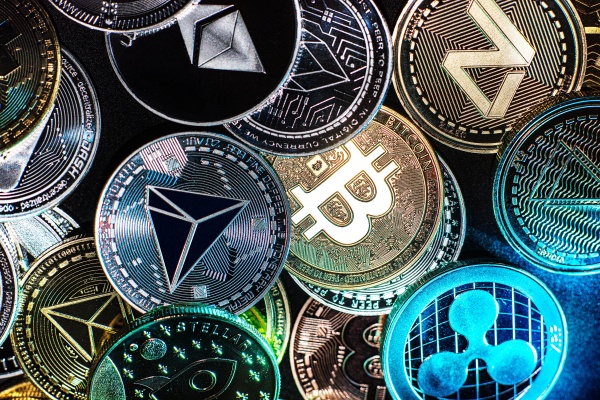
[DigitalToday reporter Jinju Hong] As the cryptocurrency market expands to about $2.7 trillion in the second quarter of 2026, investment strategies focused on top market-cap tokens are drawing attention again. An analysis says a preference for large cryptocurrencies is becoming clearer as institutional inflows, an expansion of spot ETFs and stronger regulatory clarity reinforce each other.
According to The Crypto Basic, a blockchain-focused media outlet, large assets led by bitcoin (BTC) and ether (ETH) have recently become a core pillar of institutional investment flows in the crypto market.
Bitcoin remains at the center of the market. It accounts for more than 60 percent of the total cryptocurrency market capitalization and maintains overwhelming dominance. After spot bitcoin ETFs were approved in the United States in 2024, institutional inflows expanded rapidly. Related ETF holdings reportedly rose past 1.5 million BTC to about $124 billion.
The Crypto Basic described bitcoin as "the most liquid, most trusted and most regulation-friendly crypto asset." That means it continues to serve as a core portfolio holding even as market volatility increases.
Ether was also cited as a central axis of institutional flows. It serves as core infrastructure for decentralised finance (DeFi) and real-world asset (RWA) tokenisation. It is also strengthening scalability on the back of thousands of decentralised apps (DApps) and a layer-2 network ecosystem.
More than $14 billion has already flowed into related ETF portfolios. Corporate holdings, including by BitMine Immersion Technologies, were tallied at more than 5.18 million ETH, worth about $12.3 billion. The outlet described ether as an asset with an "irreplaceable smart contract ecosystem."
In stablecoins, Tether (USDT) and USD Coin (USDC) have established themselves as core liquidity assets. Tether was emphasised as a cash-like standby asset in volatile markets, rather than an investment asset aimed at price gains. Tether's cooperation with a Big Four accounting firm to pursue its first formal financial audit was cited as a factor in expanding institutional trust. USD Coin, issued by Circle, was assessed as a core pillar for institutional payments and DeFi liquidity provision, supported by its regulation-friendliness and transparency.
Among altcoins, Ripple (XRP), Binance Coin (BNB) and Solana (SOL) were cited as major candidates in terms of institutional usability and ecosystem scalability. XRP highlighted that Ripple's global payments network is connected to 13,000 banks and processes payment flows worth about $12.5 trillion. Expectations for ETF approval were also mentioned as a major positive factor.
BNB maintains a deflationary structure that reduces supply through quarterly automatic burns. Market interest is also being drawn by the push by asset managers including BlackRock and VanEck for tokenised products based on BNB Chain. VanEck in particular has applied for the first U.S. spot BNB ETF.
Solana is ahead of a next-generation major upgrade called 'Alpenglow'. The key is to raise processing speed by overhauling the existing consensus structure. Solana co-founder Anatoly Yakovenko has said the related system could go live from the third quarter of 2026.
Cases of institutional collaboration are also continuing. Western Union launched a Solana-based stablecoin, USDPT. JPMorgan is working with Anchorage Digital on a collaboration related to reserves for a Solana-based stablecoin. The Crypto Basic called this "a signal of huge institutional trust."
Dogecoin (DOGE), Tron (TRX) and Hyperliquid (HYPE) were also mentioned as top-10 assets. Dogecoin was classified as a highly volatile asset amid strong retail investor demand and expectations for an ETF. Tron processes more than $85 billion in on-chain stablecoin transactions and maintains the top share in the USDT transfer network.
Hyperliquid entered the top tier by market capitalization on the back of strong trading volume and user growth. It was cited as featuring a structure that links most trading fees to buybacks and staking. Examples included Arthur Hayes buying more than $1 million, and a case in which $7.86 million worth of USD Coin was deployed to accumulate HYPE.
The outlet analysed that, in terms of strategy, the importance of long-term holding over short-term trading is increasing. It cited rising market liquidity compared with the past and a growing share of institutional algorithmic trading, which is rapidly shrinking short-term profit opportunities.
Accordingly, a 2026 portfolio strategy was suggested that allocates 60 to 70 percent to long-term core large assets such as bitcoin and ether, 20 to 30 percent to short-term trading in volatile tokens such as Solana, XRP and Dogecoin, and 10 to 20 percent to stablecoins for 대응 to sharp market selloffs.
The industry sees the top 10 assets by market capitalization as the leading group in terms of liquidity, institutional trust and the scale of real-world adoption, and says this is emerging as a key benchmark for future crypto investment strategies.
 Jinju Hong
hongjj@d-today.co.kr
Jinju Hong
hongjj@d-today.co.kr