
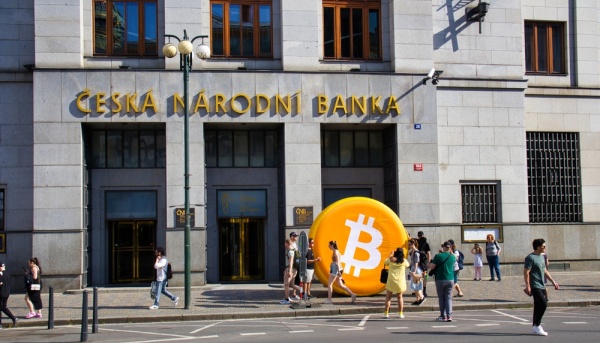
The governor of the Czech National Bank (CNB) released internal analysis showing that allocating 1 percent of foreign exchange reserves to bitcoin (BTC) would raise expected returns while leaving overall portfolio risk largely unchanged.
CoinPost, a blockchain media outlet, reported on Wednesday that Ales Michl (알레시 미흘), the CNB governor, reiterated at the Bitcoin 2026 conference in Las Vegas the need to hold bitcoin as part of reserve diversification.
The key point is that a limited inclusion of bitcoin in central bank reserve assets could improve risk-adjusted returns. The CNB focused on bitcoin’s low long-term correlation with other reserve assets. Michl described bitcoin as a highly liquid asset with characteristics closer to venture capital and said reserve management could benefit from diversification effects.
The CNB manages about $180 billion in foreign exchange reserves, equivalent to about 44 percent of gross domestic product. Michl has pursued diversification of the reserve portfolio since taking office in 2022. Over that period, the equity share rose to 26 percent from 15 percent, and the gold share expanded to 6 percent from virtually none. His comments on bitcoin are an extension of that asset allocation strategy.
The CNB first proposed using bitcoin as a reserve asset in January 2025. In November that year, it made its first digital asset purchase through a test portfolio totalling $1 million. The remarks were seen as reaffirming the existing policy of deciding whether to include bitcoin based on results from about 2 years of trial operations. The CNB also holds Coinbase shares, and is also making indirect investments in crypto-related companies.
Michl acknowledged the possibility that the price of bitcoin could go to "zero". He said equities and bonds also carry the risk of losing value, and the key is not to concentrate excessively in a specific asset. He also stressed that he would maintain a conservative stance in monetary policy while taking an innovative approach in asset management.
The remarks differ from the European Central Bank (ECB). The ECB has viewed bitcoin as lacking liquidity, safety and stability as a reserve asset. The Block reported that Stefan Uherik (스테판 우헬릭), chief financial officer at crypto wallet firm Trezor, also said, "It is as if Michl has effectively produced the opposite result." That means the CNB analysis provided a different rationale from the existing views of central banks in Europe.
In the market, there has also been talk that central banks and sovereign wealth funds could consider bitcoin as a portfolio diversification tool similar to gold in the past. Standard Chartered Bank has also pointed out earlier this year that such a trend could emerge. Against that backdrop, the Czech case is drawing attention as a precedent because trial adoption and verification at the central bank level are actually under way.
Two points will be in focus. The first is whether the Czech National Bank will formally include bitcoin as a reserve asset after the trial period ends. The other is whether the analysis results will spur other central banks to consider holding bitcoin.
 Yoonseo Lee
yslee@d-today.co.kr
Yoonseo Lee
yslee@d-today.co.kr