
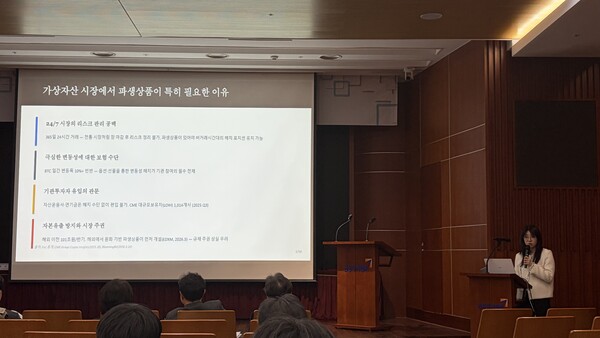
Han Seo-hee (한서희), a lawyer at Lee & Ko, presented the need for a digital asset derivatives market, overseas regulatory cases and directions for institutionalisation at a policy symposium held on April 2 at the Financial Investment Center in Yeouido, Seoul.
Han said digital asset derivatives can perform functions such as price discovery, risk hedging and improving market efficiency. She said they can also serve as a precondition for institutional investor participation.
She said the 24-hour, seven-day digital asset market is more exposed to volatility risk than traditional financial markets, making derivatives more necessary as a risk-management tool.
Han said digital asset derivatives trading is already active in overseas markets and warned capital outflows could grow if a regulated domestic market does not open.
She cited cases in which Korea-related ETF tokens or won-based derivatives are traded on overseas exchanges. She said it was highly likely that a structure could form in which Korea-related products trade overseas before they do domestically.
Han pointed to central counterparties, initial and variation margin, guarantee funds, position limits, forced liquidation and investor suitability reviews as key risk-management devices in traditional derivatives markets.
She also stressed that spot trading can transmit an individual exchange's volatility or bankruptcy risk directly to investors, while derivatives trading can block such risks through a central clearing structure.
As overseas examples, she cited the U.S. Chicago Mercantile Exchange (CME) and the Japanese model.
At CME, bitcoin futures are traded under the jurisdiction of the U.S. Commodity Futures Trading Commission (CFTC), she said. As of November 2025, they had grown to a monthly average of 424,000 contracts worth $13.2 billion, and are subject to strict regulations including cash settlement, margin of about 47 percent, position limits and circuit breakers, she said.
Japan allowed digital asset margin trading after revising the Financial Instruments and Exchange Act in 2020, she added. She said retail leverage is capped at 2 times.
Han said the domestic system is still not in a state to clearly regulate digital asset derivatives. She said if the interpretation is maintained that digital assets do not qualify as underlying assets under the Capital Markets Act, it would be difficult to apply derivatives regulations and could create gaps in investor protection and in rules against unfair trading.
As ways to institutionalise the market, she suggested pilot operations through innovative financial services, using a platform exclusively for foreigners or an overseas subsidiary, reflecting a basis for opening a market in a basic digital asset law, and a plan to list on Korea Exchange (KRX).
She said a KRX listing would require additional review, including the principle of separating industry and finance and the possibility of risk transmission to financial markets.
Han said domestic investors already have access to perpetual futures trading on overseas exchanges such as Binance, Bybit and OKX, and said discussions are needed to bring such activity into the domestic regulatory framework rather than leaving it unattended.
If digital asset derivatives are introduced domestically, they could reduce capital outflows and strengthen investor protection, while also helping ease the kimchi premium and encourage inflows of institutional funds, she said.
Han said, "If digital assets are incorporated as underlying assets in our country in the future and the derivatives market opens, this is the point in time when we need to think about to what extent to allow it by doing risk profiling."
Cheon Seong-dae (천성대), an executive director at the Korea Financial Investment Association, who joined the discussion that day, also cited institutional gaps and investor protection issues related to digital assets and added weight to the need to bring them into the regulated system.
Cheon said, "Entry barrier-style regulation is creating side effects by driving investors to illegal operators or the coin market and eroding liquidity." He said, "It is time to shift to a tailored market access system that reflects investors' level of learning and experience and the product use structure."
He added, "For digital asset-related products, we can consider not only creating a separate new market, but also incorporating them into regulated infrastructure such as the existing exchange-traded derivatives market."
 Oh Sang-youp
yub@d-today.co.kr
Oh Sang-youp
yub@d-today.co.kr