
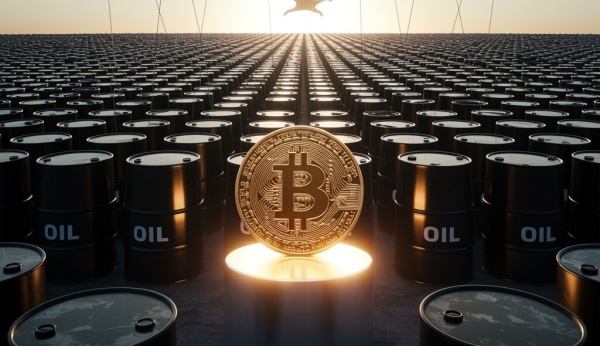
[DigitalToday reporter Yoonseo Lee (이윤서)] As international oil prices rose above $105 a barrel to the highest level in about four years, attention has turned to whether bitcoin (BTC) will undergo a large correction as in the past. On March 31 (local time), blockchain outlet Cointelegraph pointed to cases when West Texas Intermediate (WTI) trading above $105 a barrel coincided with sharp drops in bitcoin: once in 2014 and twice in 2022.
There have been cases in which a bitcoin price correction followed when WTI traded above $105 a barrel. In the past, declines of about 14 percent to 27 percent appeared within weeks. However, the sample is small, making it difficult to conclude it is a clear statistical pattern, and a more cautious interpretation is needed.
The first case was in June 2014. At the time, the Islamic State (ISIS) advanced into northern Iraq and seized Mosul and Tikrit, keeping WTI around $105. Bitcoin showed no major move in the first week, but fell from $600 to $468 in less than 10 weeks, a correction of about 21 percent. It was reported to have taken more than two years to regain the $600 level.
The second was March 2022, when oil prices broke above $105 as the Russia-Ukraine war intensified. Bitcoin slid from $44,370 to $38,100 in seven days, a 14 percent drop. However, most of that decline was recovered in less than a month, and the fact that oil stayed above $105 did not lead to an additional sharp fall in bitcoin.
The third case, and the one with the biggest drop, was May 2022. After the European Commission formally proposed a plan to phase in a ban on imports of Russian crude, WTI again rose above $105 a barrel and bitcoin then plunged 27 percent over the next seven days. Bitcoin recovered to around $39,700 only after a 19-month bear market.
The report also presented the view that interpretations that simplify the relationship as 'oil at $105 equals a bitcoin plunge' should be avoided. The correlation between oil prices and bitcoin remains uncertain, and it is difficult to infer causality from just three cases over 12 years. In 2014, the liquidation of the Mt. Gox exchange (February 2014) may have played a role, and in May 2022 the collapse of the Terra-Luna ecosystem may have deepened the bear market. Attributing a bitcoin crash to an arbitrary oil-price threshold is not convincing.
With oil back in triple digits, there are two key points to watch. First is whether bitcoin will repeat a short-term correction as in the past when rising oil prices increase volatility across risk assets. Second, even if a correction occurs, it is necessary to distinguish whether the cause is oil itself or the result of combining with separate internal market negatives, as in past cases, such as exchange or project-related risks.
As WTI re-enters a phase above $100 a barrel, bitcoin investors are increasingly wary of the possibility of a correction similar to the past. However, the cases confirmed so far do not provide sufficient grounds to directly link oil prices with a bitcoin decline. Future moves are likely to depend less on the oil level itself than on how changes in the macro environment and internal variables in the crypto market interact.
 Yoonseo Lee
yslee@d-today.co.kr
Yoonseo Lee
yslee@d-today.co.kr