
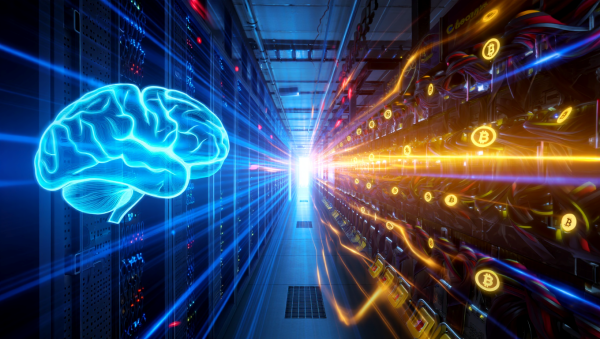
[DigitalToday reporter Yoonseo Lee] A rapid rise in artificial intelligence (AI) data centres is sparking debate that it could siphon off the Bitcoin mining industry and create security threats.
On March 16 local time, blockchain media outlet Cointelegraph reported that some experts argue that if the number of miners falls, the Bitcoin network could become more vulnerable to a "51 percent attack" - a situation in which control of a majority of the hashrate can distort transactions. Others counter that the Bitcoin network will balance itself and that mining profitability could improve.
Blockchain expert Ran Neuner (랜 뉴너) argued that AI has become the strongest competitor to Bitcoin mining. Bitcoin mining generates $57 to $129 (about 85,000 to 200,000 won) per megawatt (MW), but AI data centres earn $200 to $500 (about 300,000 to 745,000 won) with the same electricity, he said. That is why mining companies are naturally moving into AI, he added.
Examples have followed. Core Scientific secured $1 billion in credit for AI hosting, and Marathon Holdings plans to sell Bitcoin to shift into AI. Cipher Mining is also reducing hashrate and focusing on AI computing, and Bitmain co-founder Jihan Wu (우지한) has also turned to AI.
But Bitcoin developer and Blockstream CEO Adam Back (아담 백) countered that even if AI takes more electricity, mining profitability can recover again through network difficulty adjustments. Investor Fred Krueger (프레드 크루거) echoed that view, saying "Bitcoin is a self-adjusting system." Ran Neuner, however, warned that the hashrate has fallen 14.5 percent from its peak in October 2025 and that network security is weakening as a result.
By contrast, Bitcoin ESG expert Daniel Batten (다니엘 배튼) said AI and Bitcoin could form a complementary relationship. He explained that Bitcoin mining uses idle energy, serves as a flexible load-balancing function for power grids, and can use low-cost electricity even with ageing equipment. Ultimately, the key question is whether AI will replace Bitcoin or whether the Bitcoin network will find its own balance. If Bitcoin prices rise, the chances increase that miners return, but some observers also say that if the downtrend continues it could lead to a long-term crisis.
Bitcoin has recently posted five straight months of weakness, but it is up about 8 percent so far in March, signalling a rebound. As a recovery emerges after a prolonged decline, expectations are also growing in the market about a possible trend reversal.
AI has killed Bitcoin forever. It became Bitcoin mining’s biggest competitor. Not another crypto. AI. Because both industries compete for the same thing: electricity. And right now, AI is willing to pay much more for it. Bitcoin mining revenue per MW: $57 – $129 AI data… pic.twitter.com/gN23lvRSl2
 Yoonseo Lee
yslee@d-today.co.kr
Yoonseo Lee
yslee@d-today.co.kr