
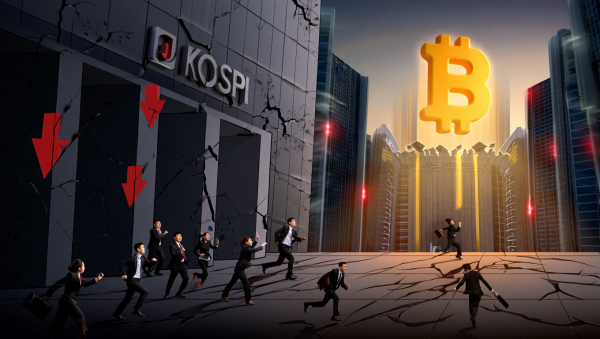
[DigitalToday reporter Jinju Hong (홍진주)] As South Korea's stock market whipsaws through plunges and rebounds, analysis suggests investors are shifting their focus to the cryptocurrency market. Given the market's heavy concentration of retail investors, some also raise the possibility that fund flows between stocks and cryptocurrencies could reappear.
CoinDesk, a blockchain media outlet, reported on March 4 local time that South Korean stocks have recently shown sharp volatility amid geopolitical tensions. Earlier this week, the KOSPI fell about 20% in two days as a speculative bubble centred on artificial intelligence-related shares deflated. A rally that had climbed nearly 180% over about 10 months on aggressive buying by retail investors cooled abruptly. Semiconductor-heavy names such as Samsung Electronics and SK Hynix led the declines, amplifying the shock across the market.
The downturn did not last long. Investor sentiment recovered quickly as the possibility of ceasefire talks between the United States and Iran emerged and the rise in global oil prices eased. Foreign investors, who had been net sellers for nine straight sessions, also turned to net buying for two consecutive days, helping the rebound.
On March 5, the KOSPI opened up 3.09% at 5,250.92 from the previous session and extended gains, surging as much as 12.21% intraday to 5,715.30. The Kosdaq also jumped, starting up 4.64% and rising more than 11% intraday. With steep losses followed by sharp gains in just a few days, South Korean stocks are showing extreme volatility.
Against this backdrop, rising trading volume in South Korea's cryptocurrency market is also drawing attention. South Korea is one of the few countries where retail investors account for a high share in both stock and digital asset markets, and many analyses say investors tend to move from one speculative market to another rather than exit risk assets altogether.
In fact, a market analysis in November last year dubbed the shift as the "Great Korean Pivot", describing how retail investors moved into AI-related tech shares as trading volume on domestic cryptocurrency exchanges declined. The view at the time was that funds moved from cryptocurrencies to AI stocks, fuelling the stock market rally.
But as the recent stock market rally has wobbled, analysis suggests the situation is changing again. Over the past 24 hours, bitcoin has gained about 7% to break above $73,000, while major altcoins such as ether, solana and XRP posted similar rises.
Still, there is also an assessment that the current move in cryptocurrencies has not expanded to the level of the speculative surges previously driven by South Korean investors. The "kimchi premium", a key gauge used to judge that, remains low.
The kimchi premium refers to the gap between bitcoin prices on South Korean exchanges and in the global market. When domestic demand surges, bitcoin trades at higher prices in the won market, widening the premium.
CryptoQuant, a cryptocurrency data firm, said the Korea premium index is currently around 1%, far below levels seen during past strong rallies led by retail investors. Some analysis also says the kimchi premium, which fell into negative territory in mid-January, has turned positive again, suggesting a slight recovery in domestic investor sentiment.
The market also raises the possibility that if volatility in South Korea's stock market grows, some retail investor funds could again shift into cryptocurrencies. Still, assessments say that for now it remains at a stage of limited growth in interest rather than a large-scale speculative rally like in the past.
 Jinju Hong
hongjj@d-today.co.kr
Jinju Hong
hongjj@d-today.co.kr