
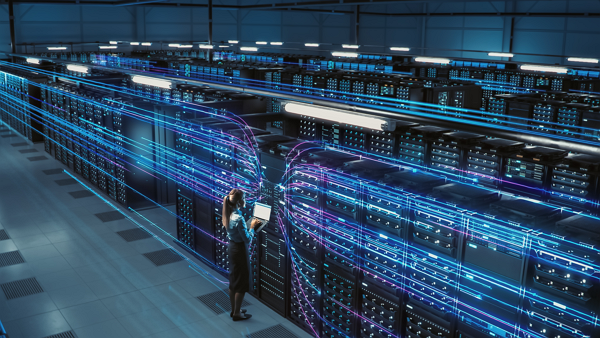
The U.S. Federal Reserve assessed that data centre and AI investment is supporting demand in manufacturing and construction even as the overall economic expansion remains weak.
On Sept. 3, local time, blockchain media outlet Cryptopolitan reported that the Fed said in the Beige Book released on Sept. 2 that U.S. economic activity rose only slightly through late August, but demand related to data centres and AI stood out in several regions.
The assessment also aligns with global flows in AI infrastructure investment beyond the Fed’s reading of the U.S. economy. Hyperscalers such as Amazon and Microsoft are leading competition for AI processing capacity as they spend money to expand data centres. The Fed pointed out that manufacturing is benefiting from orders tied to data centres and defence, and that non-residential construction is also shifting its focus toward data centres.
By contrast, the overall mood across the economy was cautious. The report, which compiled qualitative assessments from the Fed’s 12 regional reserve banks, said that based on information through Aug. 24 employment rose slightly and prices increased moderately. Businesses cited rising energy costs, policy uncertainty and international conflicts as burdens. Against that backdrop, the Fed assessed that AI is having both positive and negative effects on labour demand.
Conditions in construction were more direct. One respondent in the Chicago Fed district said, "If it were not for data centres, construction would have been in a recession." That means data centre investment is acting as a prop for parts of the construction sector. It also showed that if a slowdown in investment by large operators becomes reality, the shock to related industries could grow.
The trend is also reflected in private forecasts. PricewaterhouseCoopers (PwC) said in a global data centre outlook released on Sept. 2 that global AI infrastructure capital expenditure is expected to total $31.6 trillion cumulatively through 2050. Annual data centre capital expenditure is seen rising from about $800 billion in 2026 to $1.8 trillion in 2050. The United States is expected to account for $15.1 trillion, while Asia-Pacific is projected to absorb $8.2 trillion. PwC pointed to securing cheap, stable and low-carbon power as the biggest constraint.
Wall Street is also watching the same issue. Goldman Sachs Research said in an Aug. 19 report that while higher hyperscaler spending and improved server and model performance are positive factors, opposition to building data centres in the United States raises questions about the sustainability of the current investment cycle. The Fed’s Beige Book also said cost pressures have increased in construction and manufacturing, and it cited burdens in energy, transportation, metals and petrochemicals.
Attention now turns to the Sept. 15 to 16 meeting of the Federal Open Market Committee (FOMC). As of Sept. 2, markets priced in about a 65 percent chance of a rate hike and a 35 percent chance of no change. The shift came after Fed Chair Kevin Warsh (케빈 워시) said in an Aug. 28 Jackson Hole speech that if the pace of returning to the inflation target is not sufficiently clear and fast, policymakers still have work to do. Warsh said at the time that the Fed’s most important focus should be inflation now.
The issue is that expanding AI infrastructure investment can support the economy but also add pressure on interest rates and costs. Data centre construction lifts demand in manufacturing and construction, but it intensifies competition for power, materials, skilled labour and capital. Morgan Stanley projected that global data centre construction costs will total about $2.9 trillion through 2028, and estimated that about 25 percent of the increase in U.S. gross domestic product in 2026 could come from AI-related investment. As a result, if the Fed maintains tightening, higher procurement costs for businesses, utilities and governments are increasingly likely to affect the pace of AI expansion not only in the United States but worldwide.
 Jinju Hong
hongjj@d-today.co.kr
Jinju Hong
hongjj@d-today.co.kr