
Detailed negotiations are entering a final stage over $200 billion in strategic investment that is part of a $350 billion South Korean investment package agreed with the United States. Industry and Trade Minister Kim Jeong-gwan (김정관) said on Sept. 1, as he left for the United States, that there was a need to finalise matters related to investment in the United States. Observers say that as the United States designs semiconductor tariffs as a tool to spur South Korean companies to expand local production, South Korea is in a position where it must secure in writing a duty-free export cap proportional to the investment amount.
The Ministry of Trade, Industry and Energy said Kim will visit North Carolina, Washington, D.C., and Louisiana from Sept. 1. Kim told reporters at Incheon International Airport that a meeting with U.S. Commerce Secretary Howard Lutnick was scheduled. Under a trade agreement with the United States last year, the South Korean government allocated $150 billion of the $350 billion to cooperation in the shipbuilding industry. It is holding talks with the United States on specific projects for the remaining $200 billion in strategic investment.
In the meantime, Lutnick, the U.S. negotiating counterpart, prefers setting an upper limit on duty-free import quotas linked to the amount each company commits to produce in the United States. Politico reported on Aug. 27, local time, that the Trump administration is considering imposing tariffs not only on semiconductor chips but also on finished products containing semiconductors, including laptops, game consoles and data centre servers. Items under review also include country-by-country tariff rates and quota settings, and whether to apply country guidelines by major semiconductor makers.
The method the United States is designing would set the limit for selling semiconductors duty-free based on how much is invested in the United States. Taiwan entered this structure first. The United States lowered reciprocal tariffs on Taiwan to 15 percent from 25 percent on condition of a $250 billion semiconductor investment plan by Taiwan. It said Taiwanese companies building semiconductor plants in the United States would be allowed to export duty-free up to 2.5 times the new plant’s production capacity during construction, while those that have already completed plants in the United States could export up to 1.5 times their production capacity without paying tariffs.
The Financial Times reported that the U.S. Commerce Department is planning a way to exempt U.S. Big Tech companies such as Amazon, Google and Microsoft from semiconductor tariffs in connection with TSMC’s investment commitment in the United States. If TSMC allocates the exempted volume it secured to U.S. customers, those customers can import semiconductors without tariffs. That would put a company that invested in the United States in a position to also reduce its customers’ tariff burden.
◆U.S. aims to lure investment with tariff exemptions... what is South Korea’s response?
South Korea has received a most-favoured-nation treatment pledge that it will not be treated less favourably than other countries, but the situation remains uncertain. It has not been decided whether the 2.5-times and 1.5-times formulas applied to Taiwan will be applied to South Korea as they are, or which items will fall within the scope of exemptions.
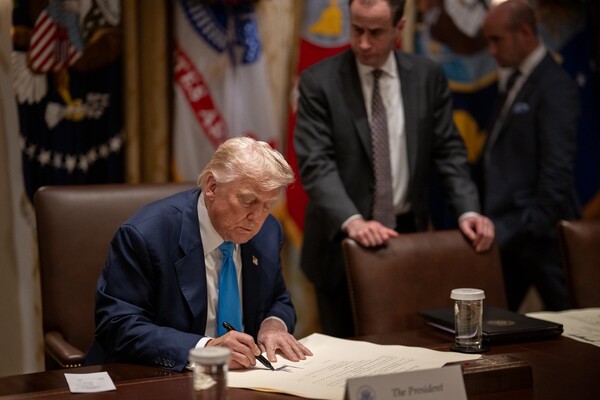
It is also causing policy confusion because it has not been codified in a written agreement. In August last year, U.S. President Donald Trump said he would impose a 100 percent tariff on semiconductors, but would not levy it even before production if production facilities were being built in the United States. In January this year, he signed a proclamation imposing a 25 percent tariff on semiconductors that are imported into the United States and then re-exported, such as Nvidia’s AI semiconductor H200. Pressure eased for a while after the U.S. Supreme Court ruled in February that reciprocal tariffs were illegal and invalid.
In the short term, the impact is limited. That is because supplies of DRAM, NAND flash and high-bandwidth memory (HBM) are in global shortage. HBM is memory that increases data processing speed by stacking DRAM vertically. Samsung Electronics, SK Hynix and Micron are expanding production facilities, but increased output will not come until 2028. If tariffs are added as memory prices rise, the burden grows for U.S. Big Tech companies that need memory for AI data centres.
The government held the 59th Trade Promotion Committee meeting on Aug. 26 at the Government Complex Sejong, chaired by Trade Minister Park Jeong-sung, to discuss response directions for pending issues including tariffs, non-tariff measures and investment in the United States. The industry ministry said it decided to marshal government-wide capabilities to support stable exports and investment by South Korean companies through information sharing and consultations among relevant ministries.
Kim also visited Washington, D.C., from Aug. 16 to 19 and met Lutnick for two consecutive days. The industry ministry said the two sides discussed key issues and timelines for candidate strategic investment projects in the United States. With investment amounts converted into duty-free caps, Kim has taken on responsibility in negotiations to put in writing the formula for calculating tariff-exemption multipliers and the range of items eligible for exemptions. An industry official said, "We cannot know anything, but since Taiwan received exemptions, we are also expecting a similar level."
 Dae-geon Seok
d2dg@d-today.co.kr
Dae-geon Seok
d2dg@d-today.co.kr