
The government will begin a full-scale push from the first half of next year to relocate administrative and public agencies. It will also launch organisational reforms, including reducing 109 public institutions, the biggest such cut on record.
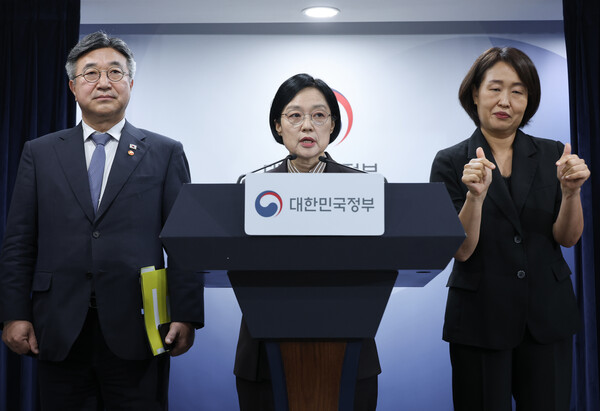
Prime Minister Han Sung-sook (한성숙) held a news conference at the Government Seoul Complex on Sept. 3 on a plan to relocate administrative and public agencies and measures to reform the functions of public institutions. "We will push ahead with the relocation of public institutions to the regions with speed," she said. She added that the government would announce relocation plans in the fourth quarter for about 350 public agencies in the Seoul area under a "principle of minimising those that remain", and begin relocations from 2027.
Han said the president has stressed avoiding "pork-barrel" style allocation. She said the government would gather energy for regional growth "like a campfire" and concentrate placements around innovation cities to maximise the strength of regional hubs.
Han said the government would break down some differences and walls of conflicting interests through gathering opinions. She said the plan is to listen to a range of views, including from local governments and labour groups, and craft a rational relocation plan that a majority can agree with.
Han said the government would provide thick support for relocation and housing assistance costs so there is no inconvenience for employees of institutions that move, and would dramatically improve living conditions such as education and healthcare. She said it would also pursue a new vision and development direction for the Seoul area, including Seoul, by strengthening economic, cultural and international exchange functions.
Land Minister Kim Yun-deok (김윤덕) said the government would fully review the criteria for remaining in the Seoul area that were applied during the first round of relocations. He said that unless an institution must remain, it would in principle be included as a relocation target.
Kim said the government would immediately begin pilot relocations from next year by using options such as leasing private buildings, rather than waiting for new office construction as in the first round. He said it would sharply raise the level of support and provide thicker support to institutions that relocate farther and faster.
The relocation of central administrative agencies concentrated in the Seoul area will be pushed in earnest from the first half of next year. The government will first seek to relocate to Sejong Special Self-Governing City institutions with large relocation scale and spillover effects.
Han called Sejong "a symbol and central axis" of balanced development. She pledged to build a presidential office in Sejong in August 2029 and place the centre of administration in Sejong, and to support the completion in 2033 of a Sejong building of the National Assembly so it proceeds without disruption. She said the government would complete the administrative capital complex city as a full-fledged centre of state affairs.
Interior Minister Yoon Ho-jung (윤호중) said the government would pursue sequential relocations from the first half of 2027, prioritising institutions with large scale or big relocation effects, such as the Justice Ministry and the Ministry of Gender Equality. He said institutions requiring separate buildings, including the prosecution service bodies and the National Police Agency, would be relocated after new offices are built.
In a question-and-answer session, Yoon said it does not mean that institutions not mentioned, such as the Financial Services Commission, are excluded. He said the government would finalise and notify the list of institutions subject to relocation by the fourth quarter. He added that the Foreign Ministry and the Unification Ministry would be reviewed for relocation in line with timing such as the relocation of the presidential office in 2030 and the opening of a branch of the legislative body in 2033.
The government plans to reduce 109 public institutions, the biggest scale on record, through strategic structural reform, consolidating similar and overlapping functions, and integrating small agencies. The reduction would amount to about 20 percent of all public institutions. Han said each ministry would prepare implementation procedures such as a functional reform roadmap, and institutions that do not require procedures such as law revisions would immediately begin implementation. She said the government would devise various support measures, including guaranteeing employment succession for workers at the relevant public institutions and providing support including pay, welfare benefits and incentives.
Deputy Finance Minister Heo Jang (허장) said the government would strategically reallocate the functions of public institutions related to national infrastructure such as energy and ports to proactively respond to rapid changes in the policy environment and future demand. He said it would pursue measures including integrating similar and overlapping institutions and consolidating overlapping work among subsidiaries and small agencies.
In connection with this, the government decided to integrate the five power generation companies into one to achieve an energy transition centred on renewable energy. It also plans to integrate four port authorities to enhance port competitiveness.
Han said the starting point of many large and small problems South Korea faces is the dominance of the Seoul region and territorial imbalance. She said balanced growth has become a survival strategy for a sustainable South Korea, not a matter of choice.
She said the announced policies, linked with initiatives such as mega projects and promoting growth engines for five hubs and three special zones, would be a turning point for easing overcrowding in the Seoul area and building regional growth drivers. She pledged to bring together the capabilities of the whole government for effective implementation of the policies. The government plans to continuously check progress through an inter-ministerial consultative body centred on the prime minister's office.
 Jin-ho Lee
jhlee26@d-today.co.kr
Jin-ho Lee
jhlee26@d-today.co.kr