
Even if an online post contains information that differs from the facts or an AI-generated image, it is not immediately classified as “disinformation” and deleted. That is because reviewers must also examine whether there was intent to cause harm or a purpose to obtain unfair benefits, and whether it infringed others’ rights or the public interest.
The Special Committee on Disinformation Review of the Korea Internet Self-Regulation Organization (KISO) held a press briefing in Seoul’s Gwanghwamun on Tuesday and, for the first time since the revised Information and Communications Network Act took effect, disclosed the status of its self-regulatory deliberations on disinformation and its criteria for judgment.
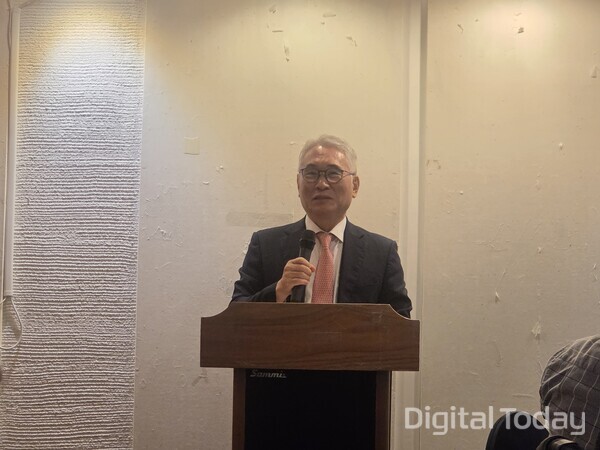
The briefing was attended by committee chair Kim Min-ho (김민호), a professor at Sungkyunkwan University Law School, and members Kim Hyun-kyung (김현경), a professor at Seoul National University of Science and Technology’s Graduate School of Public Policy and Information Technology, and Hwang Yong-seok (황용석), a professor in Konkuk University’s Department of Media and Communication, among others.
The committee reviewed 27 reported cases of suspected disinformation that KISO member companies found difficult to assess on their own and had asked it to deliberate. It completed final deliberations on 23 cases, excluding 4 cases in which posts were deleted during deliberations or temporary measures were taken following reports of rights infringements such as defamation.
It judged that none of the 23 cases qualified as disinformation under the “KISO Disinformation Self-Policy Guidelines.” As a result, there were no cases in which the committee decided on measures such as deletion or limiting exposure.
Kim said differing standards among member companies for judging disinformation could cause confusion for users and society. He added that a special committee was formed with experts in law, media, journalism and technology to apply the same criteria.
◆ Information, review and promotional posts account for 70 percent
The committee initially expected politically sensitive posts to make up most cases brought for deliberation. In practice, 19 cases, or about 70 percent of the total, were “information, review and promotional” posts, including travel agency and accommodation information, restaurant receipt reviews, cosmetic procedure reviews and product discount information. Some posts also involved disputes and disparagement, entertainment content, and claims or opinions in academic and religious fields.
Kim said, “We expected most cases to be politically sensitive issues, but more than 70 percent were posts recommending or promoting products or services, or posting reviews.”
◆ Three-step review from falsity and manipulation to purpose and infringement
The first criterion the committee applied was whether the post contained false or manipulated information. It did not judge information as false solely because some expressions were inaccurate or the information was outdated. It also examined the post’s core message and overall context, and its impact on how ordinary users perceive facts.
For example, it did not treat content as false if errors in the background or ancillary details did not materially affect users’ judgment. It also excluded subjective evaluations or opinions, and matters where objective truth is not settled, such as academic, scientific or religious debates, from determinations of falsity.
In some cases, the committee judged content to be false or manipulated information, but ultimately did not classify it as disinformation.
Kim cited examples including a post introducing an accommodation facility while using a lobby photo of an unrelated overseas luxury hotel, and a post presenting a certain substance as a cure-all while offering unrelated treatment cases. Examples also included a composite image generated by AI in which Korean signboards appeared broken, which was judged to be manipulated information.
Those posts were ultimately ruled “not applicable” because intent to cause harm, a purpose to gain unfair benefits, or infringement of others’ rights or the public interest was not confirmed.
Kim Hyun-kyung said content does not become disinformation subject to distribution bans simply because it is false or manipulated. She said three requirements must be met: intent to cause harm or a purpose to obtain unfair benefits; falsity or manipulation of the information; and infringement of others’ personal or property rights, or of the public interest.
Because it is difficult to directly confirm a poster’s intent and purpose, judgments are made based on objective circumstances. Reviewers examine factors including the relationship between the poster and the victim, whether the same information was posted repeatedly, whether indications that could verify sources were intentionally deleted or altered, and whether macros or automation technology were used to spread content in an organised way.
Unfair benefits are not limited to economic gains such as advertising revenue. They can also include social or political gains such as expanding influence or increasing followers. To prevent the scope from becoming excessively broad, the committee checks whether there are individual, direct and specific benefits.
◆ AI composites and parody assessed by context and creativity
For AI-generated content, the criterion is not the fact that it was composited or altered, but whether users could mistake it for an objective fact. If it is labelled as AI-generated or only parts unrelated to the core content were altered, it may not be considered manipulated information.
Satire and parody are also not judged as disinformation based on form alone. Hwang said that even if content is labelled as AI-generated, reviewers should comprehensively assess whether it is creative and whether it infringed specific rights or interests in a deceptive manner.
Hwang said, “If platforms are given the role of judging and filtering the truth of information circulating in the world, it can lead to the empowerment of platforms.” He said the concept of disinformation was applied minimally to prevent posts from being arbitrarily deleted based only on some errors.
Infringement of the public interest is also judged narrowly. Reviewers examine whether values protected by law, such as the quarantine system or freedom to vote, are threatened, or whether there is a risk of harm that would be difficult to recover from offline, such as a bank run, sharp swings in asset prices, or interference with disaster rescue and quarantine.
Posts related to individual rights such as defamation or invasion of privacy are handled separately from disinformation deliberations through the existing temporary measure system. In this round of deliberations, some posts that were subject to temporary measures following rights-infringement reports did not proceed to a substantive determination of whether they were disinformation.
KISO decisions are enforced not through legal force but based on agreements among member companies. If the special committee determines whether content qualifies as disinformation, the specific measures, including deletion, limiting exposure and limiting revenue, are decided by the relevant member company.
Kim said the principle of self-regulation is not to subsume all inaccurate information or rights-infringement matters online as disinformation, but to take necessary measures only for information that meets the guideline requirements. He said the committee would disclose deliberation cases and results to improve the predictability and reliability of self-regulation.
 Hojeong Lee
lhj@d-today.co.kr
Hojeong Lee
lhj@d-today.co.kr