
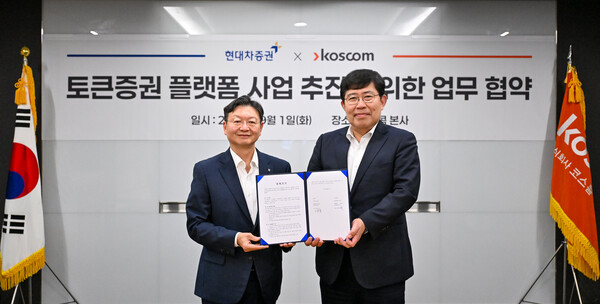
Koscom said on Tuesday it signed a memorandum of understanding with Hyundai Motor Securities on joint use of a security token platform and wider business cooperation.
Under the agreement, the two companies will cooperate on linking operations and systems for use of Koscom’s shared security token platform, developing underlying assets and products for security tokens, detailing issuance and account-management processes, running joint tests reflecting legal and institutional requirements and investor-protection conditions, and exchanging information to help invigorate the security token market.
Koscom is preparing a shared security token platform, called KoSTO, that multiple securities firms can use jointly. It has completed building security token issuance infrastructure with LG CNS and finished a testbed pilot linking with Korea Securities Depository for total-issuance management. It has also signed MOUs with 12 securities firms. With Hyundai Motor Securities joining, the number of securities firms cooperating on the shared platform has risen to 13.
Koscom is pursuing a proof of concept for security token settlement using stablecoins. It is also preparing ways to tokenise not only new types of securities such as investment contract securities and trust beneficiary securities, but also existing standardised securities such as bonds.
Hyundai Motor Securities plans to use KoSTO to efficiently establish the systems and operational foundation needed for its security token business. It also plans to identify competitive underlying assets and products to offer customers new investment opportunities.
Koscom CEO Chang-hyun Yoon (윤창현) said, "For the security token market to become fully activated, it requires not only innovation in individual products but also reliable infrastructure that can stably support everything from issuance to rights management." He added, "Through cooperation with Hyundai Motor Securities, we will enhance the completeness of the shared platform and create a foundation that allows financial investment companies to participate in the security token business at a reasonable cost."
 Chi-gyu Hwang
delight@d-today.co.kr
Chi-gyu Hwang
delight@d-today.co.kr