
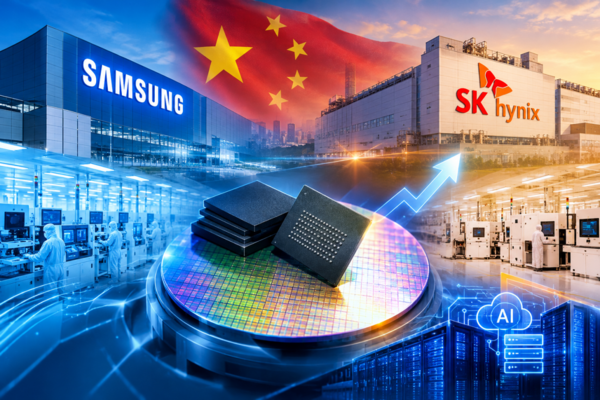
Samsung Electronics and SK hynix are moving to upgrade technology at their NAND flash production plants in China. As demand for storage devices from AI data centres grows and Chinese memory maker YMTC's market share rises quickly, the two companies are seeking to strengthen the technological competitiveness of their local production lines.
Major foreign media including blockchain outlet Cryptopolitan reported on Oct. 21 local time that Samsung Electronics is pursuing a process shift at its Xi'an plant to enable production of 286-layer V9 NAND flash. SK hynix is also speeding up equipment upgrades at its Dalian plant in China, aiming to produce NAND with 240 layers or more.
Samsung Electronics' Xi'an plant upgrade project is codenamed "Monami". The production conversion is expected to proceed in stages. The plan being pursued would expand output at the Xi'an plant from about 5,000 wafers a month in December 2026 to 40,000 wafers a month in December 2027. The Xi'an plant currently produces NAND at about the 200-layer level and accounts for about 40 percent of Samsung Electronics' total NAND output.
Samsung Electronics said the plan will proceed within the scope of U.S. export controls and focuses on meeting global customer demand through a process conversion without expanding capacity or adding new buildings. It aims to comply with regulatory limits while responding to global demand, including from U.S. customers.
SK hynix has also moved to strengthen the technological competitiveness of its Dalian plant in China. The Dalian plant is aiming to produce NAND with 240 layers or more, beyond the existing 192-layer level. The plant is a production base incorporated when SK hynix acquired Intel's NAND business in 2021 and is currently operated under the Solidigm structure. Dalian is Solidigm's only NAND production base, and Solidigm is preparing for a U.S. initial public offering.
The importance of the local market underpins the two companies' moves to upgrade their production lines in China. According to TrendForce data, China accounts for 30 to 35 percent of Samsung Electronics' NAND output and 40 to 45 percent of SK hynix's output. If technological conversion at the China plants is delayed, it could not only make it difficult to maintain competitiveness in the local market but also increase the burden on global supply chain operations.
In particular, the growth of Chinese memory maker YMTC has emerged as a risk factor. YMTC recorded a 38.5 percent share of China's NAND market in the second quarter of 2026, exceeding Samsung Electronics at 33.5 percent. SK hynix ranked third with 17 percent. Considering YMTC's full-year share in 2025 was about 28 percent, its influence in the market has expanded rapidly.
Technology development is also continuing. YMTC is known to have a high proportion of 160-layer and 232-layer products, but it has begun producing small quantities of 294-layer products and is also reviewing a shift to products with 300 layers or more. The competition over high-stack NAND technology is becoming more intense as it expands share in the Chinese market.
In terms of overall global technology levels, Samsung Electronics and SK hynix still lead. Samsung Electronics is producing 286-layer NAND based on global production standards, and SK hynix is mass-producing 321-layer NAND. However, as these latest technologies have not been sufficiently applied at local plants in China, this upgrade is seen as a step to narrow the technology gap between global production lines and China plants.
U.S. export curbs on China remain a variable. The two companies must obtain approval each year to bring U.S.-made equipment into their China plants. The U.S. government previously suggested it could restrict technology upgrades or capacity expansions at production facilities in China, but the way the regulations are operated has since changed. The two companies secured annual approvals for 2026, replacing the previous system of individual exemption approvals.
It is not clearly confirmed how much of the equipment needed for this process conversion has been approved. Whether the actual equipment deliveries and process conversion proceed as planned could be affected by the scope of U.S. export controls going forward.
Upgrading Samsung Electronics' and SK hynix's China plants is a complex task that must curb YMTC's advances while responding to demand for AI data-centre storage devices and complying with U.S. export restrictions. How quickly the two companies apply the latest processes to their China production lines is expected to affect competition in the local NAND market and their global supply strategy.
 Jinju Hong (홍진주)
hongjj@d-today.co.kr