
The Bank of Korea has kept its benchmark interest rate unchanged, but upward pressure on banks' lending rates is expected to continue for the time being. That is because the impact of the previous two rate hikes is being reflected in banks' funding costs and the possibility of additional hikes remains. There are also expectations that recent increases in banks' deposit and savings rates could push up COFIX, making it difficult for financial consumers' interest burdens to ease soon.
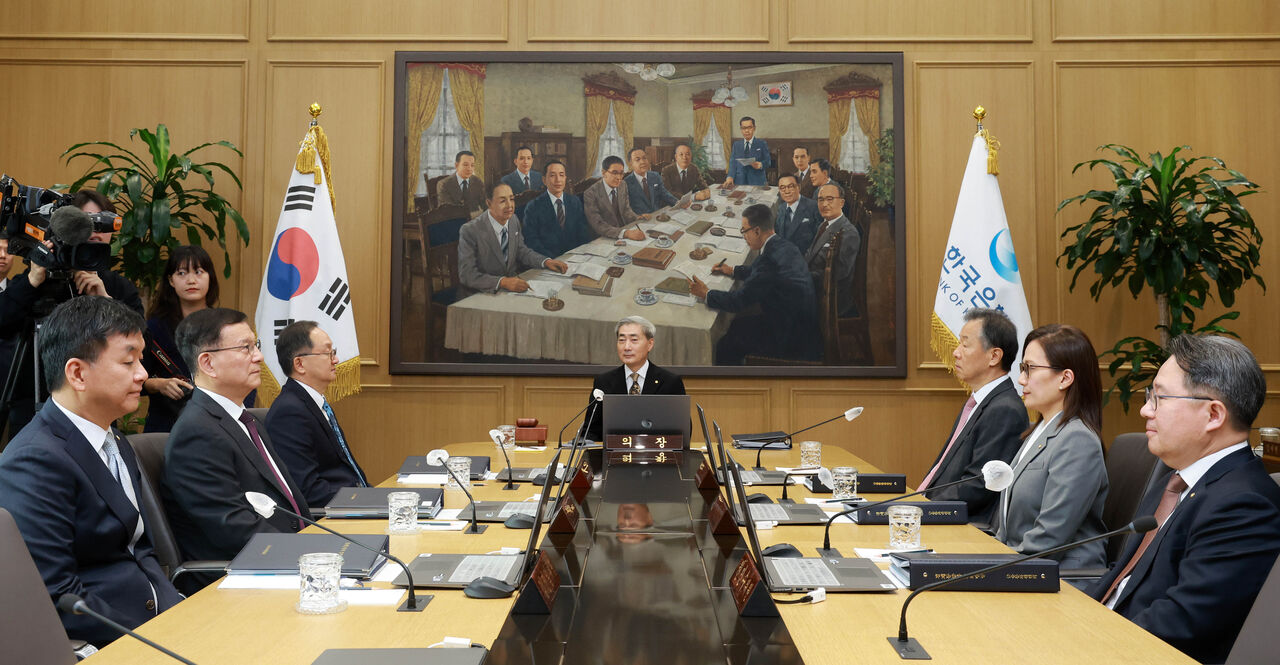
On Oct. 22, the Bank of Korea's Monetary Policy Board decided to keep the benchmark interest rate at 3.00 percent per year. The hold came after consecutive hikes in July and August, with all seven board members voting in favour.
The central bank judged that the domestic economy is maintaining strong growth and inflation pressure remains, but uncertainty has increased around the Middle East situation and major economies' monetary and fiscal policies, making it necessary to assess the impact of past rate hikes.
BOK Governor Rhee Chang-yong (신현송) said at a news conference that the previous two hikes had secured policy leeway. He also stressed that growth and inflation pressures had become stronger than in August and said it was necessary to maintain a tight monetary policy stance.
The BOK in particular expected economic growth this year and next year to rise considerably above its August forecasts of 3.3 percent and 2.9 percent, respectively. It also projected next year's core inflation rate would be higher than its previous forecast of 2.5 percent. It said whether to raise rates further will be decided based on future economic indicators.
MARKETS SEE NOVEMBER AND FEBRUARY HIKES
In the brokerage industry, some analyses say the rate-hike cycle is not over despite this month's hold.
Hana Securities, in its analysis report on the policy meeting, viewed the unanimous decision to hold and the check on the effects of past hikes as dovish factors, but judged that the possibility of additional rate hikes remains valid.
Park Jun-woo (박준우), a bond strategy researcher at Hana Securities, focused on expectations that the BOK would raise its growth and inflation outlook and that its policy statement maintained its stance of deciding the timing and pace of additional hikes. He therefore maintained his forecast of additional hikes in November this year and February next year.
Hanwha Investment & Securities also suggested a similar rate path. Kim Sung-soo (김성수), a bond strategy researcher at Hanwha Investment & Securities, interpreted the BOK's decision not to provide a separate policy signal despite expectations of strong demand as meaning there is no major disagreement with the market's priced-in terminal-rate view. The firm forecast additional 0.25 percentage point hikes in November this year and February next year, taking the benchmark rate to a final 3.50 percent, and expected it to be maintained through the end of 2027.
Market rate outlooks differed, however.
Hana Securities pointed to a move in which government bond yields fall in advance as the rate-hike cycle enters its late stage. It forecast rate volatility would expand for the time being as the real economy remains solid and external uncertainties persist.
Hanwha Investment & Securities, by contrast, expected the lower bound of government bond yields to be firm as expectations for rate cuts have largely been unwound in the market. It presented 3.80 percent per year as the lower bound for the 3-year government bond yield until the November policy meeting.
COFIX COULD RISE FURTHER; LOAN RATE BURDEN PERSISTS
With the possibility of additional benchmark rate hikes still on the table, upward pressure on banks' lending rates is also continuing. That is because COFIX, which reflects banks' funding costs, has risen sharply and is affecting floating-rate mortgage rates.
COFIX based on new loans in September stood at 3.43 percent, up 0.25 percentage point from 3.18 percent a month earlier, according to the Korea Federation of Banks on Oct. 15. It was the biggest monthly increase in 3 years and 10 months since November 2022. COFIX based on outstanding balances rose to 3.15 percent from 3.05 percent, and the new-balance-based COFIX climbed to 2.79 percent from 2.71 percent.
COFIX reflects the interest rates banks pay when raising funds through deposits, savings products and bank bonds. As the rise in the new-loan-based COFIX is reflected in floating-rate mortgage rates, the interest burden could increase not only for new borrowers but also for existing borrowers at interest rate reset points.
Fixed-rate or periodic-rate mortgages, which are affected by market rates such as bank bond yields, could show a different trend from floating-rate loans. Key variables include how much expectations for additional benchmark rate hikes are reflected in market rates and where bond yields move next.
Deposit rates are also expected to move depending on banks' funding needs, competition for deposits and swings in market rates. In particular, as banks' recent moves to raise deposit and savings rates are reflected in funding costs, they could add further upward pressure on COFIX and floating-rate lending rates.
A banking official said the benchmark rate hold is being interpreted as a brief pause rather than a change in the earlier hiking stance. The official added that, as banks are competitively raising deposit and savings rates, COFIX announced next month could also rise.
The official added that, as COFIX increases are reflected in floating-rate loan rates, lending rates are likely to remain high for the time being.
 Lee Ji-young
ljy@d-today.co.kr