
A growing number of warnings say South Korea's economy is shifting toward a structure in which a single semiconductor sector drives growth, as in Taiwan. With semiconductor exports surging to a record on artificial intelligence demand, forecasts for potential growth are rising. But concerns are mounting that gains could be concentrated in a handful of big companies, widening the gap between macro indicators and what people feel in the economy.
The International Monetary Fund recently forecast in its World Economic Outlook that South Korea's potential growth rate will rise from 1.94 percent last year to 2.14 percent this year and 2.20 percent next year. Potential growth is the maximum rate that can be achieved with labor and production capacity without stoking inflation. If realised, it would rise for two consecutive years for the first time in about 40 years. The IMF also forecast South Korea's per-capita gross domestic product will exceed $40,000 this year.
The rebound has been led by strong semiconductor exports. The Ministry of Trade, Industry and Energy said September exports totalled $120.94 billion, surpassing $120 billion for the first time on a monthly basis. Semiconductor exports in particular topped $60 billion for the first time for a single item. Cumulative exports from January to September reached $814.5 billion.
Samsung Electronics and SK hynix led the increase. The two companies are absorbing surging demand for high-performance memory driven by the spread of AI and are boosting export results. As the economy becomes more concentrated in semiconductors, some analyses say South Korea is becoming more like Taiwan than Japan, which it has long been compared with.
In both countries, semiconductors account for a large share of exports, investment and the stock market. South Korea, centred on Samsung Electronics and SK hynix, and Taiwan, centred on TSMC, play a large role in the global semiconductor supply chain. But the way the two achieve semiconductor gains differs. Taiwan also has memory chipmaker Nanya, but the growth engine is a logic semiconductor ecosystem built around TSMC. In that ecosystem, different listed companies share roles in chip design and manufacturing, back-end processing, substrates and server assembly.
TSMC, UMC and ASE, the world's largest outsourced semiconductor assembly and test company, are clustered along an axis running from Hsinchu to Kaohsiung. The Taiwan Stock Exchange said that of about 40 companies expected to apply for listing this year, more than 15 are AI supply chain companies. Taiwan Stock Exchange Chairman Sherman Lin (린) said at Computex 2026 in June, "What makes Taiwan the core of the global AI ecosystem is not a single company or technology, but a complete value chain." It is seen as a division-of-labour structure in which AI demand is captured as revenue across multiple companies.
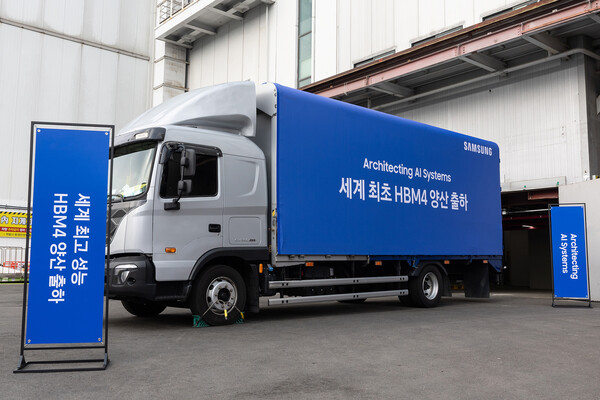
In South Korea, Samsung Electronics and SK hynix directly handle everything from producing high-bandwidth memory to packaging. Samsung Electronics does memory packaging at its Onyang site in South Chungcheong Province, and SK hynix does so at its Cheongju site in North Chungcheong Province. The two companies are also carrying out investment directly to expand next-generation HBM4 capacity.
Unlike Taiwan, it is a vertically integrated structure in which gains from the semiconductor boom accumulate first in the two companies' results. Some also warn that as the fruits of growth concentrate in a few large companies, the gap between macro indicators and the economy as experienced by the public could widen.
The Korea Development Institute warned on Oct. 12 that if the semiconductor supercycle ends, structural problems that were hidden by the boom could surface, and South Korea's economy could enter a negative-growth phase after 2030. The Organisation for Economic Co-operation and Development also lowered its estimate of South Korea's potential growth rate in June, presenting 1.66 percent for this year and 1.52 percent for next year. The OECD cited a decline in the working-age population, weaker investment and stagnant productivity as reasons for the drop.
Whether South Korea follows Taiwan's path will ultimately depend on whether it can resolve the population, investment and productivity issues cited by the OECD through the semiconductor boom. Taiwan's growth engine is currently skewed toward the semiconductor industry itself, and it is suffering a slump in domestic demand. As wage gains centred on large companies such as TSMC fail to spread across the broader private sector, real wage growth has stagnated relative to consumer inflation, and private consumption spending and sales by small merchants have recorded negative growth, showing a severe split in domestic conditions.
South Korea is also seeing slowing exports in manufacturing excluding semiconductors, and the impact of higher semiconductor output on jobs and intermediate goods demand is not large. The point, analysts say, is that to avoid Taiwan's path, South Korea needs to translate semiconductor export gains into investment in other industries such as automobiles, shipbuilding and batteries, and into domestic consumption.
An industry official said, "In the field, the perceived business conditions in other manufacturing industries have already been in a slump for the past 4 to 5 years." The official added, "With high interest rates staying high for a long time, a sharp rise in raw material prices and shrinking domestic demand, factory utilisation rates have also been lowered and companies are already in survival mode."
 Seok Dae-geon
d2dg@d-today.co.kr