
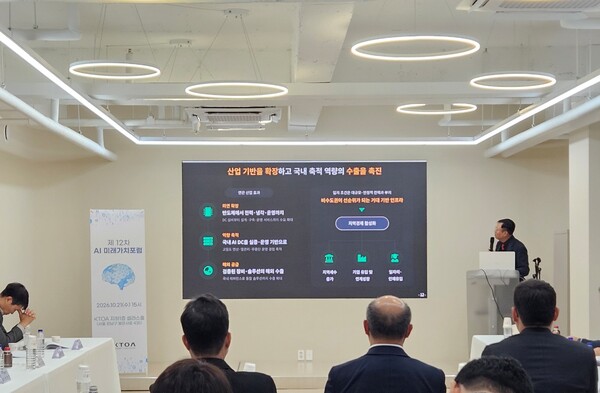
A call has emerged for fostering AI data centres (DC) as "AI factories" that produce AI computing resources rather than simple information storage facilities. The argument is that they can become a national asset through economic spillover effects such as job creation and balanced regional development. The need for government policy support, including tax credits, was also stressed.
The Korea Telecommunications Operators Association (KTOA) held its 12th AI Future Value Forum on Oct. 21 at the KTOA Building in Seoul's Gangnam district under the theme, "South Korea's AI sovereignty and global competitiveness: AIDC law, policy and industry strategy."
Lee Young-tak (이영탁), vice president of SK Telecom's AIDC integrated task force, said at the forum, "We should attract big tech AI computing demand to Korea, produce intelligence and export it abroad." He said global AI services should have a production base built in Korea and be made a national asset.
SKT is pushing to establish a GW-class AIDC. It plans to roll out 5GW of AI infrastructure in stages from 2029 and expand to 15GW by 2035, at what it described as Asia's largest level. Lee pointed to the Ulsan AI DC as a flagship project. The 100MW Ulsan AI DC, whose construction began in September last year, is being built with a target to start operations in 2027. SKT plans to grow it into a 1GW AIDC by continuing cooperation with global big tech companies including Amazon Web Services (AWS).
Lee stressed that AIDCs have greater economic spillover effects than other IT infrastructure. According to a September analysis by the National Assembly Research Service, the production-inducing effect of a 105MW AI data centre was estimated at about 3.5 trillion won, and the value-added creation effect at about 1.3 trillion won. A July survey by Hankook Research found that 71 percent of respondents in South Korea supported building AIDCs. The high support rate reflected expectations for balanced regional development.
He also stressed the need for deregulation. He specifically called for easing "grid code" regulations. Grid codes are connection rules that power plants or large power-consuming facilities must follow when connecting to the power grid. They require functions such as maintaining connection status and not separating from the grid all at once even if problems arise, and keeping voltage stable.
Lee said, "A grid code system is needed, but the regulation must not be excessive and become an obstacle to attracting big tech investment," adding, "Tax credit benefits are also needed as it creates various economic effects."
Song Do-young (송도영), a lawyer at Jipyeong LLC, introduced key details of draft sub-regulations for the "Special Act on Promoting the AIDC Industry," which is scheduled to take effect on March 10 next year.
The special act, promulgated in June, includes support for building and operating AIDCs and easing related regulations. Details such as support targets and standards for applying special provisions must be spelled out in sub-regulations including the enforcement decree and enforcement rules. The Ministry of Science and ICT held a public discussion last month and gathered opinions on the sub-regulations. The sub-regulations could be put up for legislative notice as early as next week.
A key point is exemption from power system impact assessments. The special act allows certain non-capital-region AIDCs under a certain power capacity to be exempted from the assessment. Whether an exemption applies is judged based on the maximum demand power contracted with an electricity retail business operator. The specific upper limit for power capacity is set by the enforcement decree after consultations among relevant ministries.
Permitting procedures will also be simplified. It introduces a one-stop processing system under which related agencies review documents in parallel when a business operator submits the required documents at once. Statutory processing deadlines will apply, including 150 days for power system impact assessments, 90 days for consultations on energy use plans, 90 days for reviews on traffic, landscape and construction, and 40 days for building permits and fire service consent. The enforcement decree draft allows deadline extensions of up to 30 days only in special cases.
Some facility installation standards will also be eased. When calculating requirements such as parking lots and the obligation to install artworks, AIDC-only spaces such as computer rooms where servers are installed and cooling equipment rooms will be excluded from floor area calculations. The measure reflects the characteristics of facilities that have fewer resident staff and are operated around equipment, unlike general buildings.
Standards will also be set for recognising an AIDC to qualify for special provisions. Key criteria include whether AI accelerators such as graphics processing units (GPU) and neural processing units (NPU) are installed, power density per rack, and whether power and cooling facilities are secured. It also considers the share of AI equipment in total power for information and communications equipment, or the absolute scale of AI equipment power. Specific benchmark values will be set later in a separate notice.
Moves are also under way to designate special AIDC zones outside the capital region. The Ministry of Science and ICT will review applications from local governments by examining power demand, plans to secure infrastructure and measures for regional co-prosperity. It will support infrastructure construction in designated zones, including roads, energy storage facilities and ultra-high-speed communications networks.
In a panel discussion moderated by Korea University professor Lee Sung-yup (이성엽), participants agreed that structural problems blocking AIDC expansion must be resolved, including securing power, selecting sites and permit delays. An opinion was also presented that excessive speed should be avoided. Son Geum-ju (손금주), a lawyer at Yulchon LLC, said, "Academia should also continue to monitor what impact the AIDC special act will have on the industry."
KTOA plans to continue policy discussions to raise the effectiveness of the AIDC special act and foster a domestic AI infrastructure ecosystem based on opinions presented at the forum.
 Jin-ho Lee
jhlee26@d-today.co.kr