
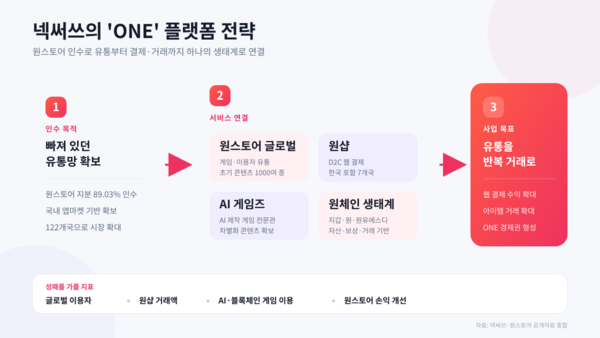
Nexthrust has expanded the game distribution network it secured through its acquisition of OneStore into global markets. It plans to combine services it has built separately, including its mainnet, wallet and web payments, with OneStore. The strategy is to shift into a platform that covers everything from game distribution to payments and transactions within a single ecosystem.
According to the industry on Sept. 1, OneStore launched OneStore Global on Aug. 31 in 122 countries including North America, Central and South America and Asia. The initial catalogue includes about 1,000 titles. It also introduced OneShop, a direct-to-consumer payment platform that integrates OneStore's existing web payment service with Nexthrust's Cross Shop.
More important than the launch countries and the number of titles is how the two services are connected. If OneStore Global is a distribution network that gathers games and users, OneShop is a payment network that turns user spending into transactions. Nexthrust is seeking to build a game platform differentiated from existing app markets by combining AI games and blockchain infrastructure.
AI and blockchain games target app market niches.
It will not be easy for OneStore Global to compete head-on with Google Play and Apple's App Store as a general-purpose app market. Nexthrust's chosen direction is to first secure blockchain games that face distribution constraints in existing app markets and a growing number of AI games.
OneStore Global applies the same content review standards to regular games and blockchain games. It also does not restrict the type of blockchain network and wallet used. Developers can launch a game simultaneously in 122 countries with a single build.
The strategy aims to attract blockchain game companies by differentiating from existing app markets that apply separate policies to games that combine virtual assets and tokens. If it supplies only the same content as existing app markets, users have little reason to choose a new app market. If it secures games that are hard to find elsewhere, it can bring in early users.
'AI Games', which lets users run AI-made games without installing them, will also be applied to the global OneStore within September. Nexthrust is seen as seeking to establish itself as a key distribution channel for AI games by grouping generative AI games in a dedicated section.
Still, accepting a wide range of content alone does not create competitiveness. Whether the initial lineup of about 1,000 titles leads to actual installs and usage, and how much AI and blockchain games account for within it, will be the standard for judging the differentiation strategy.
OneShop is tasked with monetisation, linking distribution to payments.
OneShop is responsible for connecting the games and users secured by OneStore Global to Nexthrust's revenue. It will be offered in 7 countries including South Korea, the United States, Japan and Taiwan as a D2C channel where game companies sell items directly to users on the web without going through in-app payments in app markets.
Game companies can sell items for a 5 percent fee excluding payment gateway costs. Because it uses the existing OneStore in-app payment specifications, they can adopt OneShop without an additional game build.
If OneStore Global secures users, it can direct them to OneShop through in-game links and the OneStore app. Game companies lower payment fees, while OneStore takes a cut of fees generated on the web.
This link between distribution and transactions is also what Nexthrust targeted through its acquisition of OneStore. It aims to move beyond distributing games and collecting payment fees to securing recurring revenue each time item trading and web payments occur.
The key is transaction volume. Even if the number of games on the platform increases, OneShop will not generate revenue if users do not buy items. That is why OneStore Global's performance should be gauged by monthly users, games listed on OneShop and transaction value, rather than launch countries.
Unifying names under ONE leaves building an economic zone as a task.
Since acquiring OneStore, Nexthrust has also been reorganising its blockchain ecosystem under the name ONE. The mainnet CROSS has been renamed ONEchain, the native token CROSS has been renamed ONE, and the ecosystem's common medium of exchange CROSSD has been renamed ONEUSD.
The goal is to link OneStore and Nexthrust's blockchain services into a single business. Under the structure, OneStore Global distributes games and OneShop handles web payments, while ONEchain, wallets and stablecoins are to be gradually linked to in-game assets and transactions.
But using the same name does not mean each service immediately functions as a single economic zone. OneStore users must actually use ONEchain-based games, wallets and payment instruments for brand integration to translate into business results.
Jang Hyun-kuk (장현국), chief executive of Nexthrust, has said monthly fees from existing app and game distribution are around 10 billion won, while monthly fees from game item trading are at the level of 100 million won to 200 million won. To grow item trading into a new revenue pillar, transaction volume must expand significantly from current levels.
The remaining task is to prove profitability. OneStore posted 113.3 billion won in revenue and an operating loss of about 9.6 billion won last year. Jang has presented September as the point when OneStore would reach a monthly break-even point.
Nexthrust also posted 5.8 billion won in revenue and an operating loss of 5.3 billion won in the second quarter this year. Net profit was 8.1 billion won, but it reflected a one-off gain of 15.7 billion won arising in the OneStore acquisition process. As OneStore's results are set to be fully reflected in consolidated financial statements from the third quarter, OneStore Global and OneShop must become new revenue sources that improve profit and loss rather than merely expanding the business area.
Ultimately, the first report card for the ONE strategy depends on whether distribution leads to transactions, rather than entry into 122 countries or about 1,000 titles. It must link global users to OneShop payments and blockchain game transactions and achieve a monthly turnaround to profit at OneStore for the acquisition to be evaluated as a new growth foundation for Nexthrust.
An industry official said, "The performance of OneStore Global will be confirmed in actual users and payment conversion rates rather than launch countries or the number of titles." The official added, "OneShop and blockchain transactions must lead to recurring revenue for Nexthrust's platform integration strategy to have business meaning."
 Ho-jung Lee
lhj@d-today.co.kr
Ho-jung Lee
lhj@d-today.co.kr