
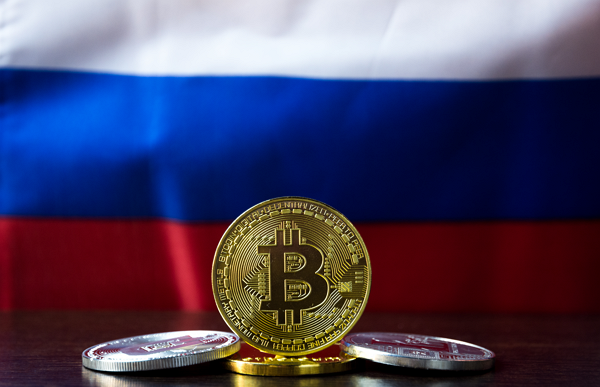
Russia will partly legalise cryptocurrency investment and trading from Sept. 1, local time.
Blockchain media outlet Cryptopolitan reported on Aug. 31 that Russia, as it implements a bill on “digital currency and digital rights”, will broaden access to digital assets for its citizens, including non-professional investors, while continuing to ban cryptocurrency payments inside the country.
The law passed both chambers of Russia's parliament in July and was signed by President Vladimir Putin (블라디미르 푸틴) in early August. It is the first full-fledged regulatory framework to bring cryptocurrency investment and trading into the formal system in Russia.
Under the rules, Russia residents can buy digital assets depending on eligibility requirements, but must do so through licensed intermediaries registered with the Central Bank of Russia. Only approved banks, securities firms, trust managers, securities exchanges and digital depository institutions can handle transactions. Digital depository institutions are a newly introduced category of custodians.
Existing cryptocurrency exchanges must also obtain new approval from the Central Bank of Russia (CBR). To be recognised as a legal exchange, it must meet a requirement of at least 15 million roubles in own capital. The central bank has not yet disclosed a list of approved trading platforms.
The market will also open to non-professional investors, but the scope will be limited. Retail investors will be able to buy mainly tokens with high liquidity and large market capitalisation. The current list includes bitcoin, ethereum and Tether's stablecoin USDT, and Russian authorities said they may add more cryptocurrencies in the future. These restrictions do not apply to professional investors and import-export companies.
Non-professional investors will also be allowed to buy cryptocurrency only up to 300,000 roubles a year per intermediary. All investors must also take a test by the Central Bank of Russia to confirm they understand the nature and risks of the products they intend to buy.
The ban on domestic payments will also remain. Under constitutional provisions, only the rouble and the digital rouble, which will be introduced in phases from Sept. 1, will retain legal tender status. The Central Bank of Russia officially announced the launch of the digital rouble in a press release on Aug. 31 and said it would open the central bank digital currency (CBDC) system to the public in several stages.
On overseas payments, Russian companies will be allowed to use cryptocurrency as a means of international settlement. Some companies have already used the method under an experimental regime launched last year, and the law will turn it into a permanent system. It was designed as a way to bypass fiat currency-based sanctions and restrictions imposed after Russia's invasion of Ukraine.
Transfers to self-custody wallets will not be allowed, but existing holdings can be legalised by depositing them in custodial wallets. Opening wallets on overseas exchanges or remitting cryptocurrency abroad will not be banned, but such activity must be reported to the Federal Tax Service of Russia and involve a domestic intermediary.
By defining cryptocurrency as property, the law will also allow transfers and inheritance, and division of assets in divorce. Up to 30 million people in Russia are estimated to hold some cryptocurrency, and related daily trading volume was reported to be 50 billion roubles.
Anatoly Popov (아나톨리 포포프), deputy chairman of the board at Sberbank, Russia's largest bank, said annual trading volume through licensed exchanges could reach 4 trillion roubles in the first year of legalisation. Total trading could rise to 5.25 trillion roubles in 2028 and 7.5 trillion roubles in 2029, he said, adding that growth could accelerate after investors secure licences in July 2027.
Russia chose to integrate cryptocurrency not through a full-scale acceptance but by limiting it to investment and external payments. Whether the market expands is expected to depend on disclosure of the list of licensed exchanges, expansion of approved tokens and the pace of the digital rouble rollout.
 Yoonseo Lee
yslee@d-today.co.kr
Yoonseo Lee
yslee@d-today.co.kr