
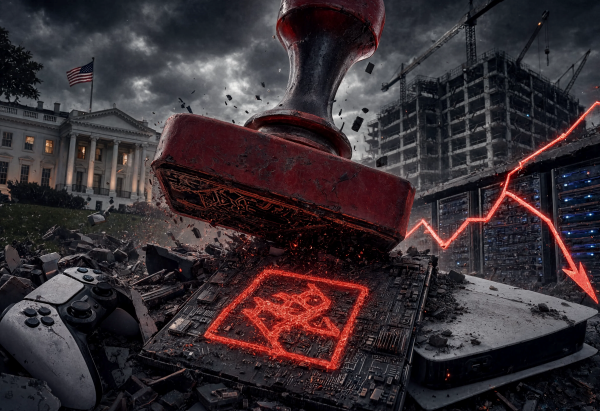
The Trump administration is considering new tariffs on semiconductors and a broad range of finished products containing chips, fuelling concerns that the U.S. artificial intelligence industry could take a direct hit.
On Aug. 27 (local time), IT outlet Ars Technica reported that the industry sees the tariff push as coinciding with data center investment and AI infrastructure expansion, potentially weakening U.S. technological competitiveness.
Options under discussion include a scenario in which tariffs apply not only to semiconductors themselves but also derived products such as game consoles and data center servers. The possibility that used or refurbished products could also fall under the tax scope is being mentioned. The tech industry expects such a move to raise costs across the semiconductor supply chain and increase the burden on U.S. companies procuring equipment.
The biggest sensitivity for the industry is data centers. The Computer & Communications Industry Association estimated in June that if such tariffs take effect, U.S. gross domestic product would fall by about $90 billion a year and about 20 percent of data center projects planned through 2030 could be delayed or cancelled. A warning was also issued that data center investment could move outside the United States.
The impact on the consumer market is also being raised. Prices for everyday devices such as smartphones, laptops, tablets, smartwatches, connected devices and vehicles could rise, and the launch of new products featuring the latest AI functions could be delayed. The industry said, "Consumer devices are the main interface through which Americans access AI tools," and pointed out that higher device prices could also slow the pace of AI adoption.
The semiconductor supply environment is also not favorable. High-performance semiconductors are expected to remain in short supply through 2027 due to global competition to expand data centers. In that situation, additional tariffs could increase price burdens for U.S. chip design companies that rely on overseas foundries for production, such as Nvidia and AMD. Apple could also be put at a disadvantage compared with overseas competitors that do not face tariff burdens, according to the concerns raised.
Within the Trump administration, some mitigation measures are also under review. One approach would allow a certain volume to be imported duty-free on the condition that foreign companies invest in semiconductor production in the United States. Commerce Secretary Howard Lutnick (하워드 러트닉) is reported to favor that approach. But with a plan to apply different tariff rates by country also being discussed, companies' supply chain calculations could become more complicated.
The problem, the industry says, is that the duty-free volume would be unlikely to meet actual demand. A tech industry official said, "Even hyperscalers alone would fill up the duty-free volume," adding, "If you also factor in the rest of the industry, there are many chips you cannot buy in the United States right now. That is because there is still no production capacity." Another official said, "The numbers simply do not add up."
Industry pushback is more direct. A source from a major industry group said of the plan, "It may be the most foolish way imaginable to pursue U.S. AI hegemony," adding, "It is like bending your own knee at the starting line." Tech companies and lobbying groups have increased contacts with the administration since early summer, but the recent direction of talks is reported to be shifting against the industry.
Earlier, Trump introduced limited semiconductor tariffs early this year that explicitly excluded data centers. In May, U.S. Trade Representative Jamieson Greer (제이미슨 그리어) mentioned the need for semiconductor tariffs but said "the right timing and the right scale" were important. But the tone appears to have shifted after the Commerce Department submitted a report on July 1 to determine whether to maintain the data center exemption. That report has not yet been made public.
To reduce the worst shock, the industry proposed exempting AI server semiconductors and lowering an assumed 25 percent tariff rate to 10 percent. It is also calling for avoiding a structure that imposes taxes twice on semiconductors and finished products. The industry argues that expanding semiconductor production in the United States will take time, and policies that raise the cost of imported chips now could collide head-on with AI infrastructure expansion.
 Seungah Yoo
ysah@d-today.co.kr
Seungah Yoo
ysah@d-today.co.kr