
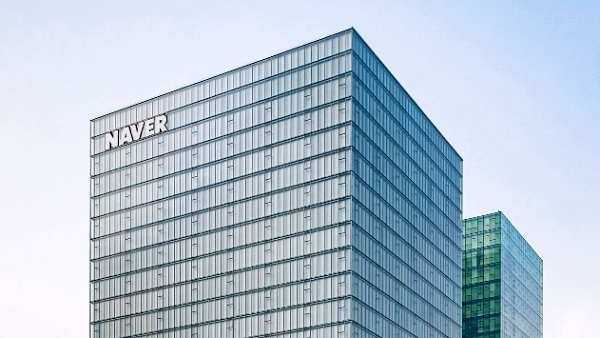
Naver has had its research results in spatial intelligence, including 3D space reconstruction, autonomous driving and world models, recognised in succession at a global computer vision conference. Four of its 23 accepted papers were selected for "ECCV Spotlight", awarded to about 1 to 2 percent of all submissions.
Naver said on Thursday that 23 papers from Team Naver technology organisations, including Naver Labs, Naver Labs Europe, Naver AI Lab and Naver Cloud, were accepted as regular papers at the European Conference on Computer Vision (ECCV) 2026.
ECCV is a major international conference in computer vision, including video and image processing, and is held every 2 years. This year's event will be held in Sweden from Sept. 8 to 12, and Team Naver researchers plan to present the accepted papers on site.
The accepted research spans vision AI, including 3D space perception and reconstruction, image and video learning models, and robot driving simulation. In particular, it includes multiple technologies for restoring real spaces in 3D or enabling robots and autonomous driving systems to recognise their surrounding environments.
Naver Labs Europe will unveil BLASt3R, follow-up research to the existing 3D reconstruction technology DUSt3R. BLASt3R applies simultaneous localisation and mapping (SLAM), which enables a robot to estimate its position while moving and build a map of its surroundings.
This enables 3D space reconstruction in an on-device environment and improves processing speed and accuracy compared with existing models. DUSt3R, unveiled in 2023, restores a space in 3D using 1 to 2 photos.
Naver Labs' InSpace research addressed a technology that generates indoor structures and objects in 3D space based on a single 360-degree panoramic image. This paper was selected for ECCV Spotlight.
Research using vision-language models (VLM) in autonomous driving environments was also accepted. The technology recognises objects not trained in advance and reflects them in a real-time bird's-eye view (BEV) map, focusing on expanding the range of object recognition in autonomous driving systems.
Naver AI Lab will present the Seoul World Model research it conducted jointly with KAIST. It is a model that generates long-range videos reflecting real urban environments based on spatial data such as panoramic images across Seoul.
Naver sees the technology as usable for map-based virtual exploration, digital twins, and autonomous driving and robotics simulation. The Seoul World Model research was also included in ECCV Spotlight.
Naver Cloud presented research to identify the meaning of images and videos more precisely. Regular papers accepted included research that distinguishes object movement and actions in video and research that combines language-based reasoning with images to identify spatial information.
Team Naver placed four papers, including InSpace and the Seoul World Model, in ECCV Spotlight at this conference. Spotlight is awarded to about 1 to 2 percent of all submitted papers.
Naver has been getting double-digit numbers of papers accepted each year at major computer vision conferences including ECCV, the Conference on Computer Vision and Pattern Recognition (CVPR), and the International Conference on Computer Vision (ICCV). It plans to apply related research to AI and spatial intelligence technologies and services.
 Hojeong Lee
lhj@d-today.co.kr
Hojeong Lee
lhj@d-today.co.kr